AWP vs LA Festival of Books

Los Angeles hosted two large book events within two months, and I attended both. Was one better than the other? I think not. They both focused on their audience and did so quite well.

March was abuzz with AWP and the writers who visited from across the country and internationally to make the city grand!

Association of Writers and Writing Programs hosted 12,000 writers, editors, publishers, book sellers, college programs, and others at the LA Convention Center. Amazingly, I didn’t just attend. I also presented for the first time! I was on the “New Literary Forms for a New Los Angeles” panel moderated by Claire Phillips. Along with Claire, I was proud to accompany writers Steph Cha, Sesshu Foster, and Gina Frangello.

Challenge number one was to calm my nerves! This was my first time presenting at AWP. The closest I’d ever gotten to presenting at AWP was participating in an off-site event alongside my publisher, Another Chicago Magazine, at AWP Seattle in 2023. But practice paves the way for perfection. And practice I did, even though my goal wasn’t to be perfect. I just wanted to be prepared enough so that if I made a mistake, I’d be able to regain composure and keep it moving.

As an attendee, I made my way to the panel “Do the Hustle: How to Publicize Your Book.” Luckily, I am reaching that yearned-for point in the writing process in which I get to focus now on submission, marketing, and publicity. So, it was great hearing how authors are clearing their own pathways to sales in an era in which publishers do less book promotion.

The panel “Literary Production During Authoritarian Governments” hit the right notes of concern and caution given our current administration in D.C. I share in the presenters’ belief that it’s imperative we continue writing and resisting during this era of book bans and limited funding.

“We Beautifully Outside: Informal Writing Collectives, Community and Kinship” was a wonderful reminder of the power of writing groups and how they have nurtured Black women writers in Los Angeles, Sacramento, and Seattle.

In April, LA Festival of Books had about 160,000 people in attendance and was more about casual engagement. Let’s face it, at AWP writers are speaking to their peers — the toughest audience sometimes.

Because AWP and LA Festival of Books were back-to-back in the same city, I picked up on the different tone right away. At the book festival, authors speak to their readers. So, the presenters delve into the content of the text more so than the writing process that led to its creation. Their presentation is more relaxed because they want to meet their audience halfway, and their audience is simply out and about enjoying their weekend.

For me, panel number one was “Existential Memoirs.” As a writer of hybrid memoir, I search out this genre. The panel was moderated by Gina Frangello, my co-panelist at AWP, and included authors Meghan Daum, Lyz Lenz, and Glynnis MacNicol. The women covered a wide range of topics including relationships, motherhood, the humor of daily life, and the horror of contemporary politics.

And finally, the “Speak Out” panel on writing and activism was moderated by journalist Jonathan Capehart and included authors Ibram X. Kendi, Aida Mariam Davis, and Rita Omokha. I loved that this panel had a Pan African scope, with presenters of US, Ethiopian, and Nigerian heritage. Their call to activism was rooted in US reality but stretched across the African/Black diaspora and highlighted the need to act locally and analyze globally as we draw on Black activism from the past to traverse the winding roads of an uncertain future.

Kendrick Lamar, LA Street Culture, and Memoir Writing

During the week of the Kendrick Lamar Pop Out Concert scheduled for Juneteenth in Inglewood, I was busy reviewing my research on the history of Watts. Watts figures in the penultimate chapter of the hybrid memoir I am writing because I owned a home (or a few mortgages) for five years – 2004 until 2009 — in that unincorporated area of Los Angeles. Since I am mixing the history of Los Angeles with my own personal experience as a writer in this city, I knew that in writing about Watts I needed to include some history on the Watts Uprising of 1965. Both the research in my manuscript and my statements here draw heavily on the article by Alex Alonso titled “Out of the Void: Street Gangs in Black Los Angeles.”

The Watts riots of 1965 that were sparked by police officers using excessive force on a Black family during a traffic stop were pivotal in the history of street gangs in Los Angeles. After six days of riots that left thirty-four people dead, L.A.’s rival gangs focused on unity and the ability to work together. And they were successful during a three-year period.

 At the Pop Out concert, Kendrick and others reflected on his concert’s ability to draw rival gangs and various other participants together to celebrate the Juneteenth holiday commemorating the end of Black enslavement. But why gangs? And how do gangs figure into the history of the City of Compton and greater Los Angeles?

As Alonso clearly delineates, Black gangs in Los Angeles developed as a reaction to the white racism that was fundamental in founding this country. As Black migrants left the segregated South and their numbers grew in the rapidly industrializing Los Angeles of the 1940’s, Black residents sought homes beyond the Central Avenue corridor to which they were limited by racially restrictive covenants. The KKK and white teenage hate groups like the Spook Hunters organized to keep Black residents from moving into predominantly white parts of South LA and adjacent cities such as Downey, Compton, Lynwood, and South Gate. Black teens formed their own clubs in order to protect their neighborhoods and combat the white violence being perpetuated against them and their families.

Over the years leading up to the Watts Uprising, South L.A. and cities like Compton became increasingly Black resulting in little need for these groups of Black youths. Yet the formations remained within the deteriorating political and socioeconomic environment of the era, and many of the Black gangs began to engage in Black-on-Black violence. L.A.’s Crips and Bloods gangs filled the void left by former street clubs that had engaged in the positive street behavior which initially resisted white racism and then advocated for Black power. And street violence began to mirror Black socioeconomics as gangs on the Eastside battled with the more upwardly mobile Westside gangs.

Black gangs in L.A. have always been connected to politics – initially, the politics of racism, and later the politics of the Black Panther Party and the revolutionary uprisings in Central America. Regarding the BPP, Alprentice “Bunchy” Carter who was president of the LA-based Black Panther Party was also a member of the Slausons gang. Carter and BPP member John Huggins were targets of the FBI’s counterintelligence agency COINTELPRO, and they were both killed at UCLA’s Campbell Hall in 1969. After COINTELPRO decimated L.A.’s Black Power Movement, the behavior of street gangs became “self-genocidal” in nature.

These “self-genocidal” tendencies broadened in scope during the time of revolutionary upheaval in Central America. Alonso states that between 1979 and 1988, there were more than 2,994 gang-related murders in L.A., and these occurred when the US Government was allegedly involved in facilitating the distribution of crack cocaine amongst Black gangs in order to fund the CONTRA counterrevolutionaries in Nicaragua – further proof of just how intertwined Black gangs are in the politics of not only L.A., but the nation.

When Kendrick Lamar beams onstage about members of rival gangs coming together to join him at his concert, there are layers of culture, history and politics that deserve to be reckoned with. Black South L.A. formed in resistance to white racism, and California dreamin has rarely been our state of mind no matter how many sunny afternoons fill a calendar year. So many dreams have passed on, packed up and left, been either locked up or tragically shot down. And like Kendrick said, Black L.A. hasn’t been the same since…

Unlike other cities, greater Los Angeles, like its Eastside, has demanded that its rappers stay true to the streets or connected to their working-class roots in ways that other cities have not.  That is part of LA street culture and culture, as evidenced by Kendrick’s stage, is something we live in the moment without rationalizing about history and politics. Until we must. And then we analyze to discern if the social connections are real, partial, or just make believe.

How much of the history and politics of street gangs in L.A. is conscious to Kendrick Lamar and those who celebrated both on and offstage with him on Juneteenth? That is a question I can’t answer. But I can reflect on the history and politics of this topic in my memoir which I must hastily get back to writing.

Harriet Tubman, Twitter, and Freedom

San Francisco’s City Lights Books invited Dr. Clarence Lusane to speak about his new book, Twenty Dollars and Change: Harriet Tubman and the Ongoing Fight for Racial Justice, with moderator, Justin Desmangles. As I watched the livestream on November 21 of this year, the symbolism of Tubman awakened my memory. The cover of Dr. Lusane’s book reminded me that an image of Harriet Tubman had once been my profile picture on twitter.

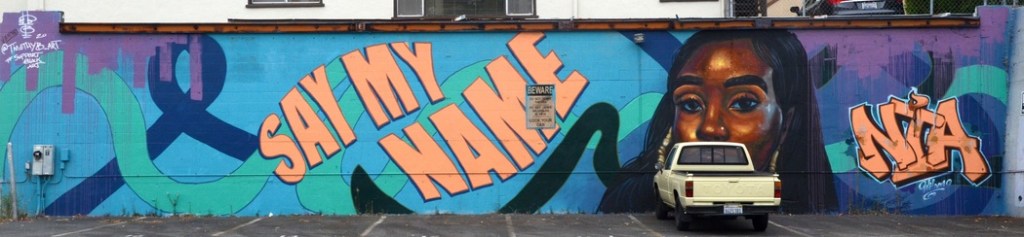
Although I might have forgotten my selection of images for social media, the reasoning and emotions behind the choice were very present. In July 2018, I craved an image that symbolized freedom for my twitter profile pic. Nia Wilson had just been murdered and her sister, Lahtifa, stabbed while they, along with a third sister, Tayisha, waited for a train at an Oakland subway station. The stabbing murder forced me to consider how Black people in the U.S. still were not free. Eighteen-year-old Nia Wilson, a Black woman, was killed by John Lee Cowell, a twenty-seven-year-old White man. Cowell had been on the same train as the sisters prior to the stabbings. And despite his expressing in court his anger about being punched by a Black woman a week prior to the stabbings, and despite his having called another Black woman the N word on a city bus as he fled the crime scene, the murder of Nia Wilson was never ruled a hate crime. For me, the physical and emotional injuries inflicted on the Wilson family, along with the seemingly countless murders of Black people that filled social media from the deaths of Trayvon Martin to Sandra Bland to George Floyd highlighted the colonial nature of Black life in the U.S. The same political and economic forces that had labelled us less than human as they drug us through the Middle Passage, that had forced us to work in bondage with, to date, no compensation, and that had deemed us second-class citizens under fascist Jim Crow were still operational.

Before choosing the Tubman pic for my profile, I’d had so many profile names and pictures during my fourteen years on the social media site that I can’t remember them. After the murder of Nia Wilson, I’d chosen Tubman because as both a runaway and an abolitionist, she symbolized freedom. Freedom from the white supremacy ingrained in capitalism, freedom to be Black and a woman, freedom to make choices about how the Black community in the U.S. chose to live, freedom to find liberatory spaces.

During my years of Twitter usage, I witnessed how the site had been instrumental in several political movements during the early part of this century – the Arab Spring, the Indignados in Spain, Occupy Wall Street, Black Lives Matter, and EndSars in Nigeria. I’d later seen counter-revolution stifle the Arab Spring when authorities began policing social media and jailing activists. In Nigeria government officials froze the bank accounts of protestors or chased them into exile. And in the overdeveloped West, authorities silenced some activists while global capitalism proved itself capable of incorporating liberals from the Indignados, Occupy, and BLM movements into the status quo of electoral politics or career activism. These were activists who had failed to base their protest on the most radical of political demands.

Prior to the Musk takeover of twitter, I’d thought of the social media site as a space where leftists could not only keep up with political developments, but also engage in conscientization and grow in leftist theory. I’d seen the joking statements made by twitter users who said they came to the site as a liberal and ended up an anarchist. Given the political space in which we found ourselves, it’s not surprising that twitter attracted Black activists. It has been a space in which Black nationalists, Pan Africanists, feminists, leftists, and radicals could converge to share ideas and battle in ideology. If Frantz Fanon and Malcolm X advocated the termination of colonialism and human degradation by any means necessary, then twitter appeared one means of doing so.

While I was aware of the contradiction of using a capitalist site like twitter as a leftist political space under the helm of Jack Dorsey, I, like countless others, am even more aware of this insurmountable irony under twitter’s new ownership. Musk’s reactivation of rightwing accounts has resulted in some liberals and radicals abandoning the site. If people haven’t quit the site altogether, many are using it less as they drift towards other social media alternatives. More importantly, other activists are more determined to do up-close organizing on the ground with marginalized and oppressed communities.

Harriet Tubman was the last profile picture I used that wasn’t my own. I didn’t remove the Tubman image because I felt that the circumstances that led up to the killing of Nia Wilson no longer existed. The needs of Black people in the U.S. and those of the global Black community are more urgent than ever. Nor did I do so because of my demoralization with leftist politics. While respecting people who choose not to use their own names and likenesses, I simply reached a point in which I wanted to acknowledge and embrace the legacy of Harriet Tubman while representing myself. I remain committed to radical liberation in the West and the termination of a political economy that underdevelops Africa as it extracts the continent’s natural resources and labor on the cheap.

Our Sleepwalking Towards Death with Gabriel García Márquez

At eighteen, with my first year of community college completed, I flew alone from Los Angeles to Mexico City. After several days of scouring bookstores, I brought back a suitcase full of novels, poetry, and history books.

I had begun my college studies as a talented Spanish major whose first published poetry — both bilingual and all-Spanish — had been accepted in Americas Review (University of Houston). As a young African-American writer whose first language was English, I shunned away from English-language literary journals because I lacked confidence they would publish my writing. Even then, decades back, I was aware that the publishing industry was a majority-White profession, and I perceived it as a barrier through which I would not be able cross. Social change, my dedication to craft, and persistence have allowed me to move beyond that barrier and get my work published in numerous English-language journals.

Given my skills in the Spanish language, I didn’t hesitate recently to read the short story, “Amargura Para Tres Sonámbulos” (“Bitterness for Three Sleepwalkers”), by Gabriel García Márquez in Spanish. Reading English translations of Spanish-speaking writers creates a thin linguistic veil between myself and the writer that I try to avoid. In the story, Márquez’s first-person-plural narration allows his two sleepwalking narrators to tell a story about a third who is a woman. The two narrators reveal to us, “Estábamos haciendo lo que habíamos hecho todos los días de nuestras vidas” (“We were doing what we had been doing every day of our lives.”) Their emphasis on the humanity of the woman sleepwalker – who lives in the underground — underscores how sleepwalking is an analogy for the process of life. On one occasion during her walk, she falls to the ground and starts eating dirt; yet, she still isn’t dead. The two narrators inform us that the more she walks around the house at night, the more she begins to look like death.

By using the sleepwalking metaphor for the process of a life approaching death, García Márquez makes the finite quality of material life abundantly clear. His magical realism presents three characters who move through the narration like phantasms of our imagination, so thinly clad that they need no names nor any physical description.

Using García Márquez’s number of three, I offer three pressing topics in the world today that we, as humanity, engage with as if sleepwalking. I will refrain from naming them, allowing the reader to use speculation (of which magical realism is a part) to discern the topics of discussion. I have likewise personified my sleepwalkers as women.

She sits at the outdoor table as clouds form in the dry atmosphere. One raindrop falls to the dark brown table as the wind blows the clouds away, assuring no rainfall. She remembers how months, years have passed with barely a sprinkle. She half gazes towards the parched earth, one eye open and the other closed, confident in the technology of dams and irrigation. Faraway, in the Southern hemisphere, no rain means starvation and death. While further off in the tropical regions, torrential rains flood the land, washing away homes and livelihoods, and later leaving stagnant waters that breed disease. Lucky, she puts on her dark sunglasses and feels the warmth of the sun lulling her to sleep.

Six hundred years of extraction on the Atlantic side. Six hundred years! She enters the house, unties the Ankara fabric from her head, rushing to complete her studies while there is electricity. Recalling the words of the professor in class today, she ponders the extraction first of people and then minerals, natural resources, and land from the continent. She must find that chapter her professor was referring to. She sits in the chair, resisting sleepiness, and begins flipping through pages. There it is. She reads how the West and others have ensured that full industrialization of products cannot happen on the land, that the profits are drained away to far-off corners of the world and not given to them — the rightful owners of the wealth. She then sits back, the hanging light flickering off and on, and starts to doze.

She knows that nothing can resuscitate a life that is gone. There is no incubator for a dead body. She saw the bullet hit, pierce skin, spew blood across the linoleum floor, stop a vital organ. The life was lost. She is not sure whether it was a shopping mall, a church, or a schoolroom. Stretched out on the carpeted floor, she covers her head with the blanket to hide from the reality of twenty to forty percent of the world’s guns in her one country. Something about a law written on paper 240 years ago. End of question. End of discussion. End of life.

African Americans’ Move to Nicaragua

Given persistent economic inequality and disproportionate mass incarceration, in the twenty-first century African Americans require territory for a national homeland.  Malcolm X is the most prominent of recent embodiments of this desire conceived of by Black Americans.  He is a tireless spokesperson and advocate for a national territory, as is Martin Delany who promotes this idea developed by the Black generations of his era.  Living from 1812-1885, Delany was physician, abolitionist, writer, husband, father, and a Civil War soldier who like Malcolm X was preoccupied with Black liberation and what it would look like in his time period as one of 600,000 freedmen amongst 3.5 million enslaved African-Americans.  He expresses the popular point of view of that time that “we (Black Americans) are a nation within a nation.” [i]  His preoccupation led him to conclude that real liberation and access to progress, for the freedmen at least, would require leaving the United States where whites owned everything as a result of their dependence on black labor.  Although whites would historically make it appear that Blacks were sequestered and forced to engage in hard labor because of their inferiority, the opposite was actually true; they were seized due to their superior abilities in activities like mining and agriculture.

Another idea circulating during Delany’s lifetime was the notion of repatriation of the African-American enslaved to Africa.  Delany was critical of this project which he regarded as conceived of by white slaveholders.  Namely, the American Colonization Society proposed to send Blacks to Liberia, an African nation created by the United States.  Depending on the political climate in the U.S., Delany considered this notion to be plausible, and at other times not.  He set sail for Africa, became familiar with the terrain and environs of Liberia, and finally concluded that he had an “unqualified objection to Liberia.”[ii]  But that conclusion would not stop him from later contemplating East Africa as a potential homeland for Black Americans as well as Lagos in present-day Nigeria.

Ultimately, Delany reasoned that the optimum location for an African-American homeland would be Central America.  Given its location and terrain, Delany saw Nicaragua specifically as an excellent location for agriculture and commerce.  His perception was that there was no racism in Nicaraguan society and that colored people wielded power.  He stated, “Central and South America are evidently the ultimate destination and future home of the colored race of this continent.”[iii]  His focus on Nicaragua was in no way unusual during his time period given that there was an obsession with Nicaragua amongst the white American ruling class.  During the 1850’s, members of the U.S. government had considered annexation of Nicaragua in an attempt to distribute land and eventually enslaved Black persons to white non-slave holders.  In other words, then, as today, the notion of Jeffersonian, white-male equality depended on both the exploitation of non-whites and the acquisition of territory outside the United States.  But was this land free of racism as Delany had perceived it to be?  Not quite so.  Nicaragua was a site of “ethnic cleansing”[iv] as practiced by the Spanish on the indigenous populations.

A closer look at race in Nicaragua reveals it not to be the idyllic environment as envisioned by African-American freedom fighter and liberationist Delany.  As contemporary researcher Lancaster points out, “Nicaragua does indeed have a race problem, or perhaps more to the point, a color problem, that manifests itself in insidious ways.”[v]  The minority populations of African and Miskito (Amerindian) origin are both concentrated and isolated on Nicaragua’s Atlantic Coast which was colonized by the British and which shares no direct highway link to the rest of the country.  Historically, the majority mestizos (persons of mixed blood), who themselves comprise 90% of the population, have considered Afro-Nicaraguans and Miskitos as backward and inferior.  Perhaps Delany perceived of Nicaragua as being free from racism due to the more subtle manifestations of racism in Latin America where this social malady is a series of practices as distinct from racism in the U.S which is structural.[vi]  Despite racism’s subtleties in Nicaragua, the leadership positions of the country have historically been held by the white elite who are noted as being the only demographic in the country not engaged in the internal and psychological warfare resulting from performing Spanish culture in indigenous or African skin.  This colonial warfare is noted by researcher Lancaster as being reversed only once per year, during carnival, when indigenous and African cultures are celebrated.  At other times, through both language and practice, the majority of the population exhibits a pervasive desire to be white.

Nicaragua as a nation continues to be a point of contention as current President Ortega struggles to retain power.  Ortega, who participated during the 1980’s in the leftist Sandinista revolution to overthrow U.S.-friendly dictator Somoza, has shifted his beliefs from Marxist-Leninism to democratic socialism.  Ortega’s terms as President include 1985-1990 and subsequent terms following elections in 2006, 2011, and 2016.  While some U.S. democratic socialists support Ortega and many U.S. Marxists and anarchists criticize him, the disparate groups tend to agree that the U.S. government, through its financing of NGO’s and human rights organizations, is trying to destabilize the present government viewed by the U.S. as being too friendly with both China and Russia.

Which way freedom?  Like African-Americans, the peoples of Nicaragua have had to struggle, engage in warfare, and face death and the death of loved ones in the quest for freedom during the eras of exploration and exploitation of the American continent, an exploitation that continues today.  Regarding economic issues in the formation of a nation, Delany often emphasizes business; yet, history shows that as businesses grow, they conglomerate and monopolize which results in a constraining of freedoms as their leaders cease to operate in the interests of working people.  Decisions about how businesses operate must be democratically shared with working people.  Regarding the freedoms of women, Delany correctly states that “no people are ever elevated above the condition of their females.”[vii]  Nicaragua today ranks twelve (after Germany) in gender equality.  Homosexuality is legal, discrimination against the LGBTQ community is illegal, but same-sex marriage is not recognized.  Unlike many other countries in the Southern hemisphere which focus on the growing of a few crops for international distribution, the country produces 80-90% of its own food.[viii]

Martin Delany, who, like Malcolm X, expresses a deep love for Black people, consistently has our freedom on his mind.  The physician Delany was one of the first three Blacks admitted to Harvard Medical School in 1850, but they did not attend because protesting white students blocked their attendance.  Martin Delany states that if we Black Folk cannot leave the U.S. and found our own nation, we should at the least establish our own schools and colleges.  Delany proposes that African Americans leave a homeland for our children.  This same Martin Delany who was so preoccupied about a homeland died in 1885 with no tombstone marking the land holding his humble grave in Ohio until the year 2006.  Martin Delany resonates through time and beyond his grave.  His advocacy is persistent and pertinent.

[i] Howard Brotz, African-American Social and Political Thought, 1850-1920 (New York: Routledge Press, 2017), 97

[ii] Brotz, African-American Social and Political Thought, 77

[iii] Brotz, African-American Social and Political Thought, 82

[iv] Roxanne Dunbar-Ortiz, “Native Land and African Bodies, the Source of U.S. Capitalism,” Monthly Review 1 February 2015

[v] Roger N. Lancaster, “Skin Color, Race, and Racism in Nicaragua,” Ethnology Vol. 30, No. 4 (October 1991): 339-353

[vi] Lancaster, “Skin Color, Race, and Racism in Nicaragua”

[vii] Brotz, African-American Social and Political Thought, 92

[viii] Kevin Zeese and Nils McCune, “Correcting the Record: What is Really Happening in Nicaragua,” Monthly Review 23 July 2018

Blatant Brazil

“Blatant Brazil”

Esteemed Brazil:

(Police, Army, Militias)

There were less blatant ways to kill Marielle Franco.


Foremost being before her African ancestors made their captured voyage to shore,

they could have simply jumped ship into the depths of the Atlantic as seaweed carcasses,

and her seed would have never settled in your soil.


Or her forebears could have been the first to rebel like Haiti and world capital and

empire could have slowly sanctioned her off, starved her and blamed her for her own

hunger.


In our times you might have choked her father for trespassing on any public street and

left her whirling to organize protest against his murder only to die breathless with no

beating heart.


You might have given her child a plastic gun to play with in a park and rushed in

annihilating both her and her offspring.


Finally, you could have stopped her car for a traffic violation, hauled her to jail to accuse

the accused of hanging herself.


Instead Marielle Franco was shot while driving Black, assassinated along with her driver

Anderson Pedro Gomes.


Her only defense the votes that made her a Council Member.  Her voice that rallied

against racism, oppression, and injustice. Her mind that analyzed and made

connections.


Brazen Brazil:

(Police, Army, Militias)

Our Loss.

Your kill.


Black Women Won’t Save the World

“Black Women Won’t Save the World”

For: Erica Garner


Despite pronouncements to the contrary, Black Women won’t save the world.  Notwithstanding the circumference of the Cradle of Civilization in South Africa nestled in a locale from which all human beings originate; regardless of the excavations in Ethiopia of both Lucy and Ardi marking the evolution of homo erectus and what that signifies to the world in the evolutionary flowering of life, the act of waiting 27 years in a Mandela-like manner is far beyond the dexterity of even the most steadfast amongst us.  So, please do not expect it, since what a girl really wants is to be a first in Africa as President of the former American Colonization Society (aka, Liberia) to show the world how it’s really done following the commendable lead of Brooklyn-and the-Caribbean’s Chisholm who made her bid as leader of the entire Empire after the sea having been parted by that group of women who were so good at either whispering or shouting:

“Come along with me.”

(You know the ones.)

Those who say: “Come on now.”

“Don’t give up.”

Those that question: “Why can’t you do that, too?”

Harriet Tubman.

Sojourner Truth.

Rosa Parks.

But they can’t do it all.  They can’t continue to clean up the mess of Western Civilization epitomized in the world’s largest economy that works overtime like an oversized fan both amassing resources and throwing out products.  They can’t continue to wipe the mouths of temperamental children.  Black women will not save the world with a sweeping lift of the train of their gowns as they walk on stage and, with a Hattie McDaniel smile, accept their award.  Even though the world expects that they listen Oprah-style to its dilemmas and then offer pats on the back; even though society would have them sweeten reality like Aunt Jemima; even though segments of American politics cross their fingers waiting for Black Women to show up at the polls to circumvent the country’s tendency to worship totalitarian totems, it goes against the grain.  When all a girl wants is fresh food that can’t be bought at a liquor mart, healthcare that can’t be provided at a storefront, dignified employment that can’t be applied for amidst corporate outsourcing, ownership that can’t be acquired in economic inequality, safety that can’t be granted by the 2nd Amendment, and for her sons and daughters to live a freedom that can’t exist in a society of colored-only mass incarceration.  So, no, Black Women (who have been my sustenance) will not save a world that reduced Lucy to an objectified Sara Baartman, Hottentot Venus to be paraded around European freak shows to exhibit her large buttocks.  Regardless of their self-imposed exile to Paris and refashioning themselves to seduce á la Josephine Baker or using the both life-saving and self-effacing tools of Madame C. J. Walker to accommodate white middle-class patriarchy, they may still face a court case named the “The United States of America vs. Billie Holiday” in which their Blues cannot even be contained in a volume by Toni Morrison.  If indeed “la vida es un carnaval,” I want Black Women to formulate it, but we can’t save a world that is not of our making, a world in which mothers were historically assigned double duty and fathers were denied last names.  Fathers were depleted of even air to breathe.  Fathers had to plead, “I can’t breathe.”

Meek Mill Didn’t Get Killt (Nonfiction in 3 Voices)

”Meek Mill Didn’t Get Killt (Nonfiction in 3 Voices)”

Voice 1: In the land of curt consolations, one that is most apparent is that Meek Mill didn’t get killt although surely that could have happened in the City of New York which garnered a recent reputation for snuffing the life out of the big man selling loosies on Long Island or the youngin confined to Rikers Island based on allegations of stealing a backpack the soul of whom was stolen from him so much so that he committed suicide.  Meek Mill’s case could have been otherwise.  He escaped that fate, if escape it can be called, given the rapper has been dragging the ball and chain of probation since 2009 for an incident that occurred as a teen; yet, given that the U.S. legal system, which markets in black and brown bodies, has acknowledged no change in him, no redemption; thus, the law, its judicial representatives, and police boots on the ground watch his every move coveting a new conviction and they find it when the rapper pops motorcycle wheelies on the set of a video filming.  Illegal.  Against the law.  2-4 years jail time.  Meek didn’t get killt.  He didn’t run from the cops who then took it upon themselves to feel fear and shoot him in the back.  He didn’t attempt to be the “trillest” and say, “Officer, I want to let you know I have a weapon,” and then get shot.  Point.  Blank.  He didn’t get into an argument at the liquor store and walk down the street only to get shot in the back.  None of that.  Meek Mill didn’t get killt.

Voice 2: On that one track Meek say, “They wanna see you in the hood back when you ain’t got shit.”  That be real tho.  That’s how the United States be operating on “Young Black America.”

Voice 1: Why do Blacks total forty percent of those incarcerated yet make up just thirteen percent of the U.S. population?  And why are one-third of those on parole in the U.S. Black people?  Black people and Brown people are disproportionately locked up.  Last name from that now-gone Spanish empire that surrendered to the force of both Anglo expansion and the consequent U.S. empire?  You know the one.  Persona de Mexico?  El Salvador?  Chances of being incarcerated abundant as well.  Practice a suspect religion.  Accent a bit odd.  Low income.  Scant education.  Behind bars.

Voice 2: On that one track when Meek and Thug say, “Lost so many niggas, I went crazy, I couldn’t balance it,” that be real too.  Like, you lose your peeps, and you be fucked up from the pain, like dizzy and shit, everything is out of wack, the city gets bigger and it’s just you standin there and all the traffic is goin in all different directions, and the empty house cuz that person ain’t there no more, just things, things to be cleaned up and horded so you can keep them or toss others in those large plastic trash bags to be dumped into oblivion, but you never forget cuz those people be in your heart always and on your mind at the oddest moments and when you look in the mirror, you be seein that person, them people, and when you speak, you hear they voices, too.

Voice 1: The challenge is to resist a culture of violent obliviousness in a broader society that would have us forget because the forgetting is dehumanization not only of the forgotten but of ourselves.  After September 11, 2001 when U.S. news networks faced the hardship of paying tribute to the souls lost in the Twin Towers, I remember looking at the scrolling photos of the deceased on the tv screen and realizing how beautiful everyday Americans were.  The photos, names, occupations of the victims were portrayed uninterruptedly.  Sixteen years later, in our society that increasingly shutters the finality of death as well as institutions like jails and prisons that impose forms of death on the living, we are increasingly not offered those commemorations, words from family members, the photos.  Just this year with the tragic human losses in the Las Vegas Concert shooting, the Texas church shooting, the hundreds of dead in Puerto Rico due to Hurricane Maria, we see meager mention of the victims.  The corporate news media, which has few reasons to seek revolt, moves on to the next story.  But as the poet says:

“No man is an island entire of itself; every man

is a piece of the continent, a part of the main;

…any man’s death diminishes me,

because I am involved in mankind.

And therefore never send to know for whom

the bell tolls; it tolls for thee.”

-John Donne


Voice 2: That be trill, tho.  John Donne was ride or die way back in the day.  Those some good lines.  It may be someone else today, your homie tomorrow, but eventually, it’s us.  One of my favorites from Meek’s album is, “Relax your mind and kick your feet way up/Selling dog food tryna feed my pups.”  We’re not forgetting Meek nor the many, many locked up.

Voice 1: “We Ball”?

Voice 2: Ballin.


Eric Garner, Alton Sterling and Controlling Black Bodies in the Americas

ERIC GARNER, ALTON STERLING AND CONTROLLING BLACK BODIES IN THE AMERICAS (a text in three parts)


“Detroit’s black day laborers gathered at an informal outdoor labor market on the city’s periphery, known to local whites as the ‘slave market.’  The large ‘open air mart’ thrived between the 1940’s and 1960’s on Eight Mile Road…” (Thomas Sugrue, The Origins of the Urban Crisis)


Eric Garner (part I)


In 1770 the Municipal government of the Louisiana Territory then under Spanish rule stated it was permissible in the Territory for the Europeans to trade tobacco for African slaves.  On July 17, 2014, in the formerly-liberal now neoliberal bastion of New York City, money capital of the overdeveloped world, and once the prime destination for Blacks leaving the Reconstruction South, there was no law permitting a black man to sell individual tobacco cigarettes on the street, indeed, based on city legislation, it was strategically inconceivable and legally impermissible for a black man to do so, and it was an activity for which Eric Garner would be killed given that the police department since the mid-1990’s was fixated on what it called quality of life in the city so when a group of African-American and Latino men had the idea of selling cigarettes that they would buy from nearby states or the Indian reservation at prices cheaper than those of New York City in order to sell on the streets, especially to people similar to themselves, who, in this case, would be people going to the welfare office nearby, and for whom, the one cigarette those customers purchased might ironically indeed have been a momentary improvement in their quality of life, both alleviating stress and bought at a cheaper price, well, the New York City police did not see it that way and after the call they received from the apartment manager who, adding his complaint to the hundreds that had been made regarding this particular area because he felt pushed to his limit with the group outside his Staten Island apartment building whom he described to police as selling cigarettes and drugs on the streets, surely the mention of the word drugs would arouse the attention of the police who were familiar with this particular group and specifically with one 43-year-old man named Eric Garner, impossible to miss at 6’2”, 395 pounds, a husband and father of six who had already been arrested twice the same year because his selling of cigarette loosies was not in accordance with state tax law.

The fact that Mr. Garner was known for buying ice cream for children in the area was  inconsequential as was his history for being a type of referee amongst the group of men with whom he hung around who would at times get into their own brawls, and the reality of Mr. Garner, a husband and father of six, working in a trade that he had made part of his livelihood was likewise irrelevant, but the fact that Eric Garner was himself breaking up a fight between his buds that day proved fatal because the plain clothes cops focused on him and this time it was Garner they wanted to arrest for selling cigarettes, and despite the big man asking that they not touch him, they proceeded in any case, with one particular cop grabbing the huge Garner, who suffered from various health conditions, by the neck and tackling him down to the ground in a chokehold, pressing his face to the cement, handcuffing him, and leaving him on the ground where Garner made his now famous pleas stating, “I can’t breathe, I can’t breathe,” eleven times, all of which were recorded on the phone camera of one of Eric Garner’s friends, but the cops ignored his pleas because somewhere in their training or due to the dozens of arrests they had made at this same spot or most likely because quality of life mandates did not include the life of someone who looked like Mr. Garner and who worked in the informal economy, they concluded that his pleas for help were fake which might be the reason that instead of Eric Garner receiving a professional group of medical personnel to attend him, he was sent what appeared to be five fake medics one of whom walked around carrying the oxygen that was never administered to the patient who suffered from acute asthma and who died after the cops succeeded in being the catalyst for Eric Garner’s cardiac arrest.

The Americas (part II)

The tragedy of Alton Sterling was to have been born in a state that historically more than one European country had fought to the death for – not only death amongst Europeans – the deaths of the original Native American inhabitants of the land and the African slaves imported as property.  Louisiana, as the former center of colonial slave trading in the United States, was contested ground not unlike my birthplace of California.  They are both states in which the presence of more than one colonial European power resulted in a fight for geographical dominance and economic and military control.  One of the most pernicious and exploitive forms of domination was European ownership of black persons transported from Africa as slaves.  Although the Portuguese initially had exclusive access to the coast of Africa and thus the exportation of our ancestors according to the Treaty of Tordesillas, 1494[i], the French, Spanish, and English would feud amongst themselves and with the Portuguese in order to gather the labor they needed to found and exploit the new lands they sought to conquer in the Americas.  European enslavers attempted to gain dominion over enslaved Africans by branding them according to their place of origin, this being important since enslavers placed a preference on peoples imported directly from Africa.  The Europeans sought to curb the Africans’ exposure to revolutionary ideas which they deemed more prevalent in the Caribbean holding islands than amongst Africans imported directly from the continent.[ii]  While the Europeans placed a premium on the skin brandings they put on Africans as property, they, for the most part, ignored the scarification the enslaved had put on themselves to indicate their particular African cultural identity.

The English-speaking slave traders kept rather meticulous records of sales of the enslaved, the Spanish are noted for having kept some; yet, the French kept very little data regarding sales of African slaves.[iii]  Their memorandums may have been scant, but the French administered the largest slave population of any colony in the territory of Saint Domingue which we now call Haiti.  The French domination of Saint Domingue lasted from 1659 until the years of the slave revolt ending in 1804.  Saint Domingue had a population of 800,000 slaves toiling in the cultivation and production of tobacco, cotton, and coffee as well as the monumental sugar trade that supplied 40% of that product to Europe.  With more than a thousand shipping vessels, over 20,000 French sailors, and more than 500 ships in its port at any one time, the Europeans considered Saint Domingue the “Pearl of the Antilles.”  Always wary of a coup d’état, the French would avoid importing slaves to Louisiana during the years 1729 to 1731 because the enslaved were rebelling in the Territory during those years.  And later Charles IV would block importation of slaves from the French Antilles to Saint Domingue as the Haitian revolution got under way in 1791.[iv]

The presence of the huge population of French sailors in Saint Domingue could not have been more horrific for women. “Colonized women were frequently positioned in the colonies and under slavery as concubines, mistresses, or sexual servants.”[v]  The scholar Kempadoo describes in her writings how militarized masculinity demands heterosexual sex on a regular basis.  When the French sailors of Saint Domingue did not resort to having sex presumably amongst themselves, they would rape the females from the Native or African populations.  How else to explain the emergence of Creole slaves — a new category of enslaved that was “specifically barred from…commerce” for importation to Louisiana as early as 1777[vi], again due to the preference for slaves imported directly from Africa whom the Europeans hoped to manipulate.  Black women were not only dehumanized by the Europeans placing them in the role of having to fulfill the sexual desires of the sailors.  Throughout the Americas, they were considered breeders whose “wombs were incorporated into plantation economies to increase the size of the slave population.”[vii]

The English had a monopoly on the barbarity of the slave trade by the 18th century, having surpassed both the French and the Spanish in the trafficking of human lives.  After the slave revolt in Saint Domingue during the years of 1791-1803, the Europeans moved some sugar production to Mississippi.  The Louisiana Purchase, in which this territory was transferred from French to Spanish, back to French, and finally to U.S. hands, was a manifestation of how the United States, a former colony itself, had now gained the ability to recolonize.  The incorporation of the territory which contained the largest slave market caused political anxiety amongst the political power brokers in the North. Their concerns were appeased by designating black slaves as 3/5 of a person in the U.S. Constitution, thus avoiding having the South gain excessive electoral representation.

Another colonial power that formerly controlled black lives in Louisiana was Spain. And how did the Spanish maneuver to restrain their African populations?  The Spanish designated Cartagena in present-day Colombia, as the former slave trading center of Spanish America; thus, it was the sister city of Anglo-American New Orleans.  While Anglo-American slavery was noted for being brutal and French slavery in Saint Domingue was so deadly the enslaved lived just a few years, the Spanish in their largest slave market of Cartagena are noted for having “difficulties with transportation, (an) unimaginative government, (and) powerful and myopic vested interests”[viii] all of which affected the degrees of mercilessness the Catholic Jesuits, landowners, and mine owners could impose on their African slaves. France and Spain were both Catholic countries, and the Catholic church took the position that slavery was a contract and that the slave was a human being with family rights.[ix]  While this may have been one of many laws on the books dating back as far as 1348 in Castilian legislation, it would be difficult to enforce in Colombia because of the shortage of priests to implement it.  And its application was uneven in other geographical locations of the huge Spanish American empire.  Despite their Catholicism, the French were barbaric slave owners in Saint Domingue known for working slaves to death in just a few years.  If preservation of the family unit is used as an indication of respecting the humanity of African slaves, we know that in Anglo-American slavery separation of family members was the norm.  Colombia’s rate of nuclear family units amongst slaves was anywhere from 37-60% depending on the region.  Peru and Brazil, both Catholic countries, discouraged family units amongst slaves where only 10% lived in nuclear families.  The Bahamas and Jamaica, on the other hand, are noted for having 54 and 70% of slaves respectively living in nuclear family units.[x]

Other characteristics regarding the lives of the Africans enslaved in the region now called Colombia was a life expectancy of 30 years, a mortality rate of 50%, with women giving birth to an average of 5 kids, and having, statistically, more than half die at an early age.  The ratio of men to women in the late 1700’s in the Colombia region was 109:100, which contrasts markedly with South Carolina at 180-250:100.  A particularity of Colombian slavery is the notion that the enslaved did not have to toil for the enslavers on Sundays and Catholic holidays.[xi]  This fact is important because it would allow for increased rates of manumission given that African slaves toiling in the gold mines in areas like Choco, or laboring on farms could work on Sundays and keep the profits from their work for themselves.  Retaining the profits of their labor should have allowed for increased rates of manumission given that the enslaved would be able to then purchase themselves or other family members.  Yet records indicate that the Spanish rarely disclosed the laws regarding manumission and even when the enslaved were aware of the laws, some masters refused to grant freedom.  Thus, records for the late 1700’s show that the region of Cali granted only 87 manumissions and Buenaventura, 7.  The goldmining region of Choco is distinct in having a 75% manumission rate, but this is also connected to the depletion of the gold mines in that area.[xii]  By 1785 the colonial powers in Colombia, by way of their dominion over and regulation of the lives of African slaves, had depleted the gold mines of Choco, although slavery would not officially end across the country until 1851.

Alton Sterling (part III)

“In a setting black women referred to as a slave market at Roosevelt Road and Halsted Street (Chicago), they (black female domestic workers) haggled daily for work, just as their counterparts did in New York’s ‘Bronx Slave Market.’” (Christopher Robert Reed, The Depression Comes to the South Side)


Six years, take it or leave it, six years of being an acquaintance to the owner of the Triple S Food Mart who said that Alton Sterling never got into any fights and was popular amongst the store’s shoppers who referred to him as the CD Man, with his table of cd’s and dvd’s in a cardboard box on his table propped up outside the store while playing music for his customers to both sample and lighten the load of their workday, known for extending credit to his customers who might pay him a portion of the price of the cd and return later to pay him the rest.  Alton Sterling with his cd business still extant after Tower Records filed for bankruptcy in 2006 and the Virgin Megastores’ closure in Europe and America in 2009; yet, Sterling, still the CD Man in Baton Rouge, Louisiana on July 5, 2016, despite the digital age of downloads and apps, a black man once again caught up in the whirlwind of 21st -century global capital – a tempest which at its worst functions like the bighead carp eating algae and detritus at the bottom of the Mississippi River, looking for consumables in an era when capital had deemed the music cd dead and America had opined the black working class of no regard and the black underclass, irrelevant. Here was this one African American male, father of five, selling cds in the open air in a country that had considered it more acceptable that he sell himself for labor, a country where blacks have ironically functioned as both profit and profit makers, and where independent black enterprise has always been suspect and has not been given support causing blacks to be on a tempestuous tour of the country for several decades now looking for living arrangements starting from the South after Emancipation and fleeing to the North, Midwest, and out West, currently regions subject to gentrification, especially in the major cities, where wealthy international elites buy condos and lofts in formerly abandoned downtowns presently undergoing transformation and forcing blacks, browns, working people, and the elderly to compete in their old neighborhoods with those same absentee-owner/renter elites and with middle class American whites trying desperately not to feel the crunch.

The CD Man, 37 years old, a registered sex offender, which no mom, family, or community can condone, had previously been arrested for carrying a gun and being in possession of marijuana in Louisiana which is not Alaska, California, Colorado, Maine, Massachusetts, Nevada, Oregon, Washington State, nor D.C. where marijuana is now legal, and sentenced to five years; thus, he had done time, and now engaged in his business, sole proprietor, his presence contradicting the myth that blacks are more tolerable solo than in a group – a group that can incite anxiety amongst fearful whites like the hundreds of Haitians languishing today in Tijuana having fled Haiti after the 2010 earthquake, worked in Brazil, and due to that country’s economic downturn, migrated, some on foot to the U.S.-Mexico border, where they now sit, wait, and dream the dream of entering a country which centuries ago deemed black migration en masse to the U.S. useless and which now perceives the individual black person, especially male, as a threat.  And that fateful call of the homeless man, perhaps upset that Sterling would not give him money, so he calls the police to tell them that Sterling is carrying a gun in open-carry Baton Rouge, and the two cops respond to that call ready to snuff the life out of this black man as they straddle and tackle him to the ground, during which shots are fired, and the cops emerge alive.  Alton Sterling dies to his kids, dies to their moms, dies to his customers, dies to the homeless man who used his phone to call the police, dies to the bystanders who used their phones to record the killing, dies to open-carry Baton Rouge, dies to America’s former largest slave market of Louisiana, dies to the open arms of the jails and prisons which like the rest of America is confounded about what to teach, which services to provide, job opportunities to avail, housing to rent and sell, what the future looks like for working and underclass black America, a thorn in its side since the days of freedom.


[i] Thomas N. Ingersoll, “The Slave Trade and the Ethnic Diversity of Louisiana’s Slave Community,” Louisiana Historical Association, Spring 1996, http://www.jstor.org/stable/4233285

[ii] Thomas N. Ingersoll, “The Slave Trade and the Ethnic Diversity of Louisiana’s Slave Community”

[iii] Thomas N. Ingersoll, “The Slave Trade and the Ethnic Diversity of Louisiana’s Slave Community”

[iv] Thomas N. Ingersoll, “The Slave Trade and the Ethnic Diversity of Louisiana’s Slave Community”

[v] Kamala Kempadoo, “Women of Color and the Global Sex Trade: Transnational Feminist Perspectives,” Indiana University Press, Spring 2001, http://www.jstor.org/stable/40338451

[vi] Thomas N. Ingersoll, “The Slave Trade and the Ethnic Diversity of Louisiana’s Slave Community”

[vii] Kamala Kempadoo, “Women of Color and the Global Sex Trade: Transnational Feminist Perspectives”

[viii] David L. Chandler, “Family Bonds and the Bondsman: The Slave Family in Colonial Colombia,” The Latin American Studies Association, 1981, http://www.jstor.org/stable/2503127

[ix] David L. Chandler, “Family Bonds and the Bondsman: The Slave Family in Colonial Colombia”

[x] David L. Chandler, “Family Bonds and the Bondsman: The Slave Family in Colonial Colombia”

[xi] David L. Chandler, “Family Bonds and the Bondsman: The Slave Family in Colonial Colombia”

[xii] David L. Chandler, “Family Bonds and the Bondsman: The Slave Family in Colonial Colombia”


Works Consulted


Baker, Al, David Goodman, and Benjamin Mueller. “Beyond the Chokehold: The Path to Eric Garner’s Death.” New York Times 13 June 2015.


Berlinger, Joshua, Nick Valencia, and Steve Almasy. “Alton Sterling Shooting: Homeless Man Made 911 Call, Source Says.” CNN 8 July 2016.


Chandler, David. “Family Bonds and the Bondsman: The Slave Family in Colonial Colombia.” Latin American Research Review 2 (1981): 107-131. JSTOR http://www.jstor.org/stable/2503127.


Ingersoll, Thomas. “The Slave Trade and the Ethnic Diversity of Louisiana’s Slave Community.” Louisiana Historical Association 37 (Spring 1996): 133-161. JSTOR http://www.jstor.org/stable/4233285.


Kempadoo, Kamala. “Women of Color and the Global Sex Trade: Transnational Feminist Perspectives.” Indiana University Press 2 (Spring 2001): 28-51. JSTOR http://www.jstor.org/stable/40338451.
The Charleston Nine, W.E.B. Du Bois, and the Art of Jacob Lawrence

The Charleston Nine, W.E.B. Du Bois, and the Art of Jacob Lawrence

Excerpt from “Meditations on Migration”


One soul, hundreds, thousands may hear the whistle of the early-1900’s train in Jacob Lawrence Number #5.  These are W.E.B. Du Bois’ “black refugees” who decades prior were also escaping the injustices of the vestiges of Southern slavery.  Amongst these souls, the excitement may be there, the expectation, and idealization of life in the U.S. North, especially given that Northern industry, in many cases, is paying the fare, making it quite worth the while to pick up and leave the unequal, segregated living conditions of the South.  Will Northern industry’s promise to pay transportation lead to the same indentured servitude experienced by blacks in the Reconstruction South?  Will the North be the antidote for the circumstances in the South where “the black man has simply to choose between pauperism and crime” (Du Bois)?  The experience of my grandmother was that of leaving Tennessee in the 1930’s, barely 20, the youngest of eleven children all living except the one black male disappeared into the night to never return home again.  She was the only one to take the train north to Chicago.  Or perhaps there were others in her family who went north, but they didn’t stay.  They would eventually return south.  Not she.  Her mother and father had come from Mississippi to Tennessee and as family lore would have it, her mother had Indian blood.  This was more than likely a truth, but also a bit of a digression given our black folk propensity to reach into a nebulous past and pull out our Native American blood to explain why we are not quite so black African, where the yellow, honeyed brown, and, chestnut skin colors come from.  These skin tones being a phantasmal legacy of the white rape of black females by slave owners.  This acerbic inheritance was quite apparent in my maternal grandmother’s family line, even more so in my father’s whose family, unlike my grandmother’s, took a loathsome pride in their light skin color, so much so, that my own mother was not readily accepted into their clan.  All this, yet the most important factor being it was the African blackness which held everything together and made us who we were and who we are and which is the beginning and end of our universe until eternity always loyal linking me, us to Africa, the Caribbean, the Americas, and beyond. Thus, therefore, and so forth, into the North on Lawrence’s black train, belching black smoke as the headlamp leads the way.  Iron tracks shackle southern, agricultural land “once marvelously rich but already partially devitalized by (the) careless and exhaustive culture” (Du Bois) of the slave system. Iron wheels navigate plots deceitfully promised “for eventual lease and sale to ex-slaves in forty-acre parcels” (Du Bois).  Northern industrial lords, in their bidding, analogous to the contemporary “coyotes” of the U.S. Southwest and Mexico who round up desperate immigrants and move them north with the expectation that the human smuggler will eventually be paid for his effort.


Jacob Lawrence 42 exposes a South disgruntled with the undertaking and enterprise of migration.  A white man, gun and holster on his hips, stands as an “X” at the train station door ready to arrest the two departing black passengers.  Police officer?  Sherriff?  Perhaps.  Yet this is the land in which “every white man was ipso facto a member of (the) police” (Du Bois).  And blacks were a people whose first crime in this country, and particularly in the South, was their “blackness or other physical peculiarities” (Du Bois).  Surely, there must have been more than a few residents in white neighborhoods who murmured under their breath, “Let the niggers leave.”  Before their self-ordainment as African-American.  Ante-dating their self-proclamation as Afro-American.  Prior to salvos accompanied by raised fists of black power, these Colored people and Negroes (as branded by the Spanish and Portuguese) were leaving a land that for several centuries had deemed “life amid free Negroes (as) simply unthinkable, the maddest of experiments” (Du Bois).  Still there was this despotic effort to impede blacks’ departure, blocking their train passage because, of course, the South was losing former free labor, current cheap labor, the people who made both the white landowners and the white poor feel racially superior to all other beings on earth, the women who had cleaned their houses, raised their kids.  The men and women who while working in their hot, insect-infested fields, some dropping dead to the ground and then being kicked aside, because the plough never stopped (Du Bois), still had the audaciousness to light a white, desolate world with spiritual song.  The people who should have been crushed by centuries of abuse after losing their African spiritual world but who bowed their heads down and embraced a god on a cross whose word they had to fight to read, often in secret, and to whom they had to worship in the wooden churches that would be kept separate Black Churches because they could not enter the white.  Wooden churches that could light up in burning flames of hatred at the flick of a match and still do, historically black churches, because we are a historically black people carrying history historically on our backs, historically black in Charleston when praying to that same God and subject to being shot by a white man who is not alone in thinking in his solitary mind that his whiteness is under threat and siege, shot for being historically black – Reverend Clementa Pinckney.  Say his name. Cynthia Hurd.  Say her name.  Reverend Sharonda Coleman-Singleton.  Say her name.  Tywanza Sanders.  Say his name.  Ethel Lance.  Say her name.  Susie Jackson.  Say her name.  Depayne Middleton Doctor.  Say her name.  Reverend Daniel Simmons. #Sayhisname.  Myra Thompson.  #Sayhername.  Amen.  Nine people killed.  Emanuel African Methodist Episcopal Church.  June 17, 2015.  Charleston, South Carolina.


W.E.B. Du Bois, The Souls of Black Folk, (New York: First Vintage Books, 1990).