Book Readings in the Los Angeles Area

Looking back on my past two months attending book readings in Los Angeles, I’m inspired and energized by the manner in which these gatherings create community!

Connecting on social media is great, but real life is so much better. In-real-life events allow us to detect nuances we just can’t perceive when we interact digitally. And the connections we make are more authentic and lasting.

I found and/or rediscovered literary spaces where I feel at home. And I even became a member of Women Who Submit!

So which events did I attend?

At Skylight Books in the Hollywood area, I heard Michelle Gurule talk about her new memoir on sugaring titled Thank You, John. Brandon Taylor engaged in conversation about his novel Minor Black Figures which portrays a NYC painter pondering life and art.  And Myriam Gurba read from her hybrid memoir about plants and memory titled Poppy State and then passed out seeds to members of the audience.

On the westside at Beyond Baroque, poet and author Kevin Young read from two books — A Century of Poetry in the New Yorker: 1925-2025, edited by himself, and Night Watch, his newest book.

In East LA at Espacio 1839, editor Romeo Guzman accompanied Jenise Miller, Elaine Lewinnek, and Peter Chesney as they read from their essays in the anthology Writing the Golden State while George Sanchez-Tello performed and read as well.

Toni Ann Johnson read from her short story collection But Where’s Home? at a Women Who Submit event in Highland Park.

And never to be outdone, Reparations Club in South LA hosted Michaela Angela Davis as she engaged in conversation with Authur Jafa about her memoir tenderheaded.

I closed off this sprint of events in Santa Monica by attending the PEN America Emerging Voices LA Workshop reading. It was thrilling to hear participants read from their fiction, nonfiction, and poetry and to reflect on my experience as a PEN honoree and participant last year. 

I can’t wait to see what the new year brings in readings and lit events!

The LA Opera and Memories of Fascism: Federico Garcia Lorca, Neruda, Hemingway

Would you flee a fascist state?

Given the current state of US political affairs, I was left to ponder that question as I watched the LA Opera production of “Ainadamar” at the Dorothy Chandler Pavillon downtown. In the opera, the character who plays actress Margarita Xirgu tries to convince her friend Federico García Lorca – a poet, playwright, and theater director — to flee Spain as the country hurdles towards civil war. She goes into exile, but the poet refuses to leave. Xirgu then engages with the audience to tell the tragedy surrounding García Lorca’s last days during the Spanish Civil War of 1936-1939.

Why Federico García Lorca?

Upon hearing about this opera, I was compelled to see it. As I state in my hybrid memoir manuscript, I first learned about Federico García Lorca at age sixteen when my AP Spanish Literature teacher introduced me to two poets who had a lasting impact on my own bilingual poetry – García Lorca and Pablo Neruda.

García Lorca is the most prominent Spanish writer of the early twentieth century. Born in 1898 in Granada, Spain and assassinated in 1936, his literary influences were futurism, symbolism, and surrealism. While doing recent research on his life, I realized authorities have given various reasons for his death. Most prominent amongst them is the fact that he was gay and a socialist in a country that was moving further and further to the right.

Was the Spanish Civil War a proxy war?

I am a fan of hybrid memoir, so literature inevitably leads me to history. Because I read the book The Red Flag by David Priestland a few years ago, I reflected on the historical context of the opera as I watched the L.A. production. From Priestland, I learned how the far right in Spain gained more popularity as Hitler consolidated power in and around Germany. Before World War II, Spain, France, and Chile had formed popular front governments to combat fascism. The Spanish left had one of the most successful popular fronts – communists, socialists, and left liberals — in the Western world, and they won the 1936 election.

Regrettably, the leftist victory of the Spanish Popular Front was short lived because General Francisco Franco staged a coup in 1936, the year García Lorca was assassinated. The country endured three torturous years of civil war fought not only by its citizens but also by volunteers from over fifty countries. The fascist governments of Germany and Italy supported Franco while Stalin sent arms to the political left.

While doing recent research, I learned new details about the quickly shifting politics of 1930’s Spain. I knew from Priestland that Picasso became a card-carrying communist during the civil war era. But I also discovered that Chilean poet and Nobel Laureate Pablo Neruda was on diplomatic duty in Spain where he met García Lorca. Like Picasso, Neruda became radicalized as a communist, but he also lost his diplomatic post due to his beliefs. The Chilean poet also met Peruvian poet Cesar Vallejo and attended the 1937 Second International Writers Conference that Hemingway attended.

Despite the valiant efforts of the leftist resistance and the toil of a civil war that cut short 500,000 lives, the General gained control of the country. Franco banned García Lorca’s writing until 1953 — interestingly, the year Joseph Stalin died — and maintained his dictatorship until 1975.

A surprise for me was learning that after many years of tragic war and decades of dictatorship, García Lorca’s remains have never been found.

The LA Opera’s production of “Ainadamar” — conducted by Lina González-Granados of Colombia and choreographed by Antonio Najarro of Spain – was excellent. I appreciate how it put this history and García Lorca’s art on a Los Angeles stage for us to remember and reflect on the importance of resisting the destruction and dehumanization of far-right politics.

AWP vs LA Festival of Books

Los Angeles hosted two large book events within two months, and I attended both. Was one better than the other? I think not. They both focused on their audience and did so quite well.

March was abuzz with AWP and the writers who visited from across the country and internationally to make the city grand!

Association of Writers and Writing Programs hosted 12,000 writers, editors, publishers, book sellers, college programs, and others at the LA Convention Center. Amazingly, I didn’t just attend. I also presented for the first time! I was on the “New Literary Forms for a New Los Angeles” panel moderated by Claire Phillips. Along with Claire, I was proud to accompany writers Steph Cha, Sesshu Foster, and Gina Frangello.

Challenge number one was to calm my nerves! This was my first time presenting at AWP. The closest I’d ever gotten to presenting at AWP was participating in an off-site event alongside my publisher, Another Chicago Magazine, at AWP Seattle in 2023. But practice paves the way for perfection. And practice I did, even though my goal wasn’t to be perfect. I just wanted to be prepared enough so that if I made a mistake, I’d be able to regain composure and keep it moving.

As an attendee, I made my way to the panel “Do the Hustle: How to Publicize Your Book.” Luckily, I am reaching that yearned-for point in the writing process in which I get to focus now on submission, marketing, and publicity. So, it was great hearing how authors are clearing their own pathways to sales in an era in which publishers do less book promotion.

The panel “Literary Production During Authoritarian Governments” hit the right notes of concern and caution given our current administration in D.C. I share in the presenters’ belief that it’s imperative we continue writing and resisting during this era of book bans and limited funding.

“We Beautifully Outside: Informal Writing Collectives, Community and Kinship” was a wonderful reminder of the power of writing groups and how they have nurtured Black women writers in Los Angeles, Sacramento, and Seattle.

In April, LA Festival of Books had about 160,000 people in attendance and was more about casual engagement. Let’s face it, at AWP writers are speaking to their peers — the toughest audience sometimes.

Because AWP and LA Festival of Books were back-to-back in the same city, I picked up on the different tone right away. At the book festival, authors speak to their readers. So, the presenters delve into the content of the text more so than the writing process that led to its creation. Their presentation is more relaxed because they want to meet their audience halfway, and their audience is simply out and about enjoying their weekend.

For me, panel number one was “Existential Memoirs.” As a writer of hybrid memoir, I search out this genre. The panel was moderated by Gina Frangello, my co-panelist at AWP, and included authors Meghan Daum, Lyz Lenz, and Glynnis MacNicol. The women covered a wide range of topics including relationships, motherhood, the humor of daily life, and the horror of contemporary politics.

And finally, the “Speak Out” panel on writing and activism was moderated by journalist Jonathan Capehart and included authors Ibram X. Kendi, Aida Mariam Davis, and Rita Omokha. I loved that this panel had a Pan African scope, with presenters of US, Ethiopian, and Nigerian heritage. Their call to activism was rooted in US reality but stretched across the African/Black diaspora and highlighted the need to act locally and analyze globally as we draw on Black activism from the past to traverse the winding roads of an uncertain future.

“The House on Mango Street” and a Garden in Watts

The House on Mango Street in a roundabout way helped me buy the garden in Watts. The garden wasn’t just the purple fountain grass and Mexican feather grass protected by weed fabric and surrounded by wood chips at the side of the house. But also, the papyrus grass that grew six or seven feet in front of the house. I bought the house in 2004 and watered the decorative grasses and the green St. Augustine grass every Sunday until the house went underwater, financially, in 2008. Then I sold it in 2009; and not because of the garden and not because of the house, but because of a family emergency that was more important than the house.

When Sandra Cisneros first published her novella The House on Mango Street in 1984, I had been living my period of attempted literary exile that inspired me to fly from Los Angeles to Paris in search of a city Anaïs Nin portrayed as inherently artistic. Nin told me this when I ditched eleventh grade and read her autobiography inside the newly constructed big blue Pacific Design Center on Melrose Avenue. While I was ditching at Pacific Design, the Diaz sisters also had a house on Melrose that they owned before the building was completed in 1975. Ironically, their 900-foot house sat at the front steps of the blue building until 1997 when they finally sold. Another irony is that as an adult I would hear Cisneros read from her book inside the auditorium of Pacific Design. I can’t remember now if the Diaz house was still at the entrance or not.

During my literary exile that mimicked A. Nin, J. Baldwin, and J. Baker, I sat one day on a bench in the cold of winter listening as the streets of Paris told me I needed a vocation. On the metro running beneath the streets, the Black skin – akin to my own — of Francophone Africans hinted I needed a home. I returned to Los Angeles determined to teach despite my mother rightly warning that secondary education was too much work for too little income. Cisneros’ House on Mango Street gave me something to teach. And lasting in the trenches of teaching, so you can have a livelihood, pay your rent, and maybe one day buy a house, is all about having something (you are passionate about) to teach.

Cisneros is back in the States from her current home in Mexico. Speaking at City of Asylum on October 20 for the fortieth anniversary of the publication of her book, she described her time teaching high school in Chicago and how she realized the students needed more than literature; she suggested that what they needed were social services and social change. Indeed. I agree. At the same time, I am thankful she gave me poetically crafted chapters to teach, such as “My Name,” “Marin,” and “Papa Who Wakes Up Tired in the Dark.”

As I taught, I wrote poetry. Lots of it. My first published poems were bilingual, and Arte Público Press accepted them for publication in their journal The Americas Review. At City of Asylum, Cisneros stated that House on Mango Street was first published by Arte Público – a press, she said required its writers to be better than good. They had to be excellent. I knew, without a doubt, that my poems – “La Chanteuse de Jazz,” La Pachanga,” and “Boca Oficial” were excellent. Cisneros also whispered to us during her talk that a lot of Latinx writing today is pop literature.

Mango Street not only inspired me to continue teaching; it was a catalyst for me to write my own YA novella while I lived in the house in Watts where on Sundays I tended to purple fountain grass, Mexican feather grass, and papyrus grass. Thinking back now, I can’t fathom how I wrote a novella as my marriage slowly dissolved and I stepped into the role of single motherhood responsible for two kids while tending to three dogs and a garden behind wrought iron gates.

It dawned on Cisneros as she studied creative writing at University of Iowa in her early twenties that everyone in her class had a house except her. That difference was another inspiration for her writing the novella. Did I ever think of my house in Watts as “A House of My Own” that was “a space for myself to go, clean as paper before the poem”? Considering that idea now, I don’t think so. I wrote a novella inside its four walls, but that writing occurred in a whirlwind I barely remember. The Watts house didn’t nourish my ability to write for publication; it nourished my ability to write in order to live. It, like teaching, erased the line between writing, teaching, and living until one and the other became the same.

Blatant Brazil

“Blatant Brazil”

Esteemed Brazil:

(Police, Army, Militias)

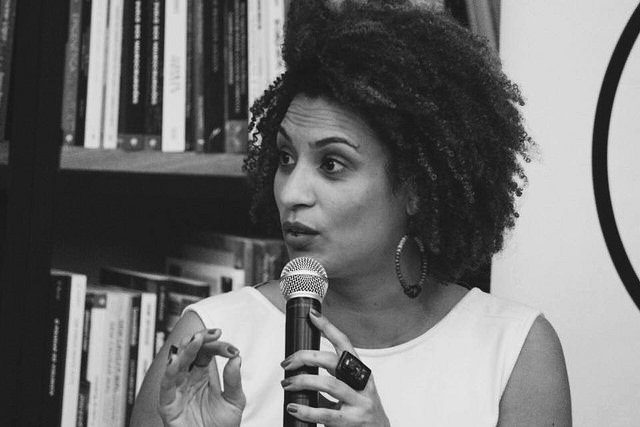
There were less blatant ways to kill Marielle Franco.


Foremost being before her African ancestors made their captured voyage to shore,

they could have simply jumped ship into the depths of the Atlantic as seaweed carcasses,

and her seed would have never settled in your soil.


Or her forebears could have been the first to rebel like Haiti and world capital and

empire could have slowly sanctioned her off, starved her and blamed her for her own

hunger.


In our times you might have choked her father for trespassing on any public street and

left her whirling to organize protest against his murder only to die breathless with no

beating heart.


You might have given her child a plastic gun to play with in a park and rushed in

annihilating both her and her offspring.


Finally, you could have stopped her car for a traffic violation, hauled her to jail to accuse

the accused of hanging herself.


Instead Marielle Franco was shot while driving Black, assassinated along with her driver

Anderson Pedro Gomes.


Her only defense the votes that made her a Council Member.  Her voice that rallied

against racism, oppression, and injustice. Her mind that analyzed and made

connections.


Brazen Brazil:

(Police, Army, Militias)

Our Loss.

Your kill.