AWP vs LA Festival of Books

Los Angeles hosted two large book events within two months, and I attended both. Was one better than the other? I think not. They both focused on their audience and did so quite well.

March was abuzz with AWP and the writers who visited from across the country and internationally to make the city grand!

Association of Writers and Writing Programs hosted 12,000 writers, editors, publishers, book sellers, college programs, and others at the LA Convention Center. Amazingly, I didn’t just attend. I also presented for the first time! I was on the “New Literary Forms for a New Los Angeles” panel moderated by Claire Phillips. Along with Claire, I was proud to accompany writers Steph Cha, Sesshu Foster, and Gina Frangello.

Challenge number one was to calm my nerves! This was my first time presenting at AWP. The closest I’d ever gotten to presenting at AWP was participating in an off-site event alongside my publisher, Another Chicago Magazine, at AWP Seattle in 2023. But practice paves the way for perfection. And practice I did, even though my goal wasn’t to be perfect. I just wanted to be prepared enough so that if I made a mistake, I’d be able to regain composure and keep it moving.

As an attendee, I made my way to the panel “Do the Hustle: How to Publicize Your Book.” Luckily, I am reaching that yearned-for point in the writing process in which I get to focus now on submission, marketing, and publicity. So, it was great hearing how authors are clearing their own pathways to sales in an era in which publishers do less book promotion.

The panel “Literary Production During Authoritarian Governments” hit the right notes of concern and caution given our current administration in D.C. I share in the presenters’ belief that it’s imperative we continue writing and resisting during this era of book bans and limited funding.

“We Beautifully Outside: Informal Writing Collectives, Community and Kinship” was a wonderful reminder of the power of writing groups and how they have nurtured Black women writers in Los Angeles, Sacramento, and Seattle.

In April, LA Festival of Books had about 160,000 people in attendance and was more about casual engagement. Let’s face it, at AWP writers are speaking to their peers — the toughest audience sometimes.

Because AWP and LA Festival of Books were back-to-back in the same city, I picked up on the different tone right away. At the book festival, authors speak to their readers. So, the presenters delve into the content of the text more so than the writing process that led to its creation. Their presentation is more relaxed because they want to meet their audience halfway, and their audience is simply out and about enjoying their weekend.

For me, panel number one was “Existential Memoirs.” As a writer of hybrid memoir, I search out this genre. The panel was moderated by Gina Frangello, my co-panelist at AWP, and included authors Meghan Daum, Lyz Lenz, and Glynnis MacNicol. The women covered a wide range of topics including relationships, motherhood, the humor of daily life, and the horror of contemporary politics.

And finally, the “Speak Out” panel on writing and activism was moderated by journalist Jonathan Capehart and included authors Ibram X. Kendi, Aida Mariam Davis, and Rita Omokha. I loved that this panel had a Pan African scope, with presenters of US, Ethiopian, and Nigerian heritage. Their call to activism was rooted in US reality but stretched across the African/Black diaspora and highlighted the need to act locally and analyze globally as we draw on Black activism from the past to traverse the winding roads of an uncertain future.

“The House on Mango Street” and a Garden in Watts

The House on Mango Street in a roundabout way helped me buy the garden in Watts. The garden wasn’t just the purple fountain grass and Mexican feather grass protected by weed fabric and surrounded by wood chips at the side of the house. But also, the papyrus grass that grew six or seven feet in front of the house. I bought the house in 2004 and watered the decorative grasses and the green St. Augustine grass every Sunday until the house went underwater, financially, in 2008. Then I sold it in 2009; and not because of the garden and not because of the house, but because of a family emergency that was more important than the house.

When Sandra Cisneros first published her novella The House on Mango Street in 1984, I had been living my period of attempted literary exile that inspired me to fly from Los Angeles to Paris in search of a city Anaïs Nin portrayed as inherently artistic. Nin told me this when I ditched eleventh grade and read her autobiography inside the newly constructed big blue Pacific Design Center on Melrose Avenue. While I was ditching at Pacific Design, the Diaz sisters also had a house on Melrose that they owned before the building was completed in 1975. Ironically, their 900-foot house sat at the front steps of the blue building until 1997 when they finally sold. Another irony is that as an adult I would hear Cisneros read from her book inside the auditorium of Pacific Design. I can’t remember now if the Diaz house was still at the entrance or not.

During my literary exile that mimicked A. Nin, J. Baldwin, and J. Baker, I sat one day on a bench in the cold of winter listening as the streets of Paris told me I needed a vocation. On the metro running beneath the streets, the Black skin – akin to my own — of Francophone Africans hinted I needed a home. I returned to Los Angeles determined to teach despite my mother rightly warning that secondary education was too much work for too little income. Cisneros’ House on Mango Street gave me something to teach. And lasting in the trenches of teaching, so you can have a livelihood, pay your rent, and maybe one day buy a house, is all about having something (you are passionate about) to teach.

Cisneros is back in the States from her current home in Mexico. Speaking at City of Asylum on October 20 for the fortieth anniversary of the publication of her book, she described her time teaching high school in Chicago and how she realized the students needed more than literature; she suggested that what they needed were social services and social change. Indeed. I agree. At the same time, I am thankful she gave me poetically crafted chapters to teach, such as “My Name,” “Marin,” and “Papa Who Wakes Up Tired in the Dark.”

As I taught, I wrote poetry. Lots of it. My first published poems were bilingual, and Arte Público Press accepted them for publication in their journal The Americas Review. At City of Asylum, Cisneros stated that House on Mango Street was first published by Arte Público – a press, she said required its writers to be better than good. They had to be excellent. I knew, without a doubt, that my poems – “La Chanteuse de Jazz,” La Pachanga,” and “Boca Oficial” were excellent. Cisneros also whispered to us during her talk that a lot of Latinx writing today is pop literature.

Mango Street not only inspired me to continue teaching; it was a catalyst for me to write my own YA novella while I lived in the house in Watts where on Sundays I tended to purple fountain grass, Mexican feather grass, and papyrus grass. Thinking back now, I can’t fathom how I wrote a novella as my marriage slowly dissolved and I stepped into the role of single motherhood responsible for two kids while tending to three dogs and a garden behind wrought iron gates.

It dawned on Cisneros as she studied creative writing at University of Iowa in her early twenties that everyone in her class had a house except her. That difference was another inspiration for her writing the novella. Did I ever think of my house in Watts as “A House of My Own” that was “a space for myself to go, clean as paper before the poem”? Considering that idea now, I don’t think so. I wrote a novella inside its four walls, but that writing occurred in a whirlwind I barely remember. The Watts house didn’t nourish my ability to write for publication; it nourished my ability to write in order to live. It, like teaching, erased the line between writing, teaching, and living until one and the other became the same.

Kendrick Lamar, LA Street Culture, and Memoir Writing

During the week of the Kendrick Lamar Pop Out Concert scheduled for Juneteenth in Inglewood, I was busy reviewing my research on the history of Watts. Watts figures in the penultimate chapter of the hybrid memoir I am writing because I owned a home (or a few mortgages) for five years – 2004 until 2009 — in that unincorporated area of Los Angeles. Since I am mixing the history of Los Angeles with my own personal experience as a writer in this city, I knew that in writing about Watts I needed to include some history on the Watts Uprising of 1965. Both the research in my manuscript and my statements here draw heavily on the article by Alex Alonso titled “Out of the Void: Street Gangs in Black Los Angeles.”

The Watts riots of 1965 that were sparked by police officers using excessive force on a Black family during a traffic stop were pivotal in the history of street gangs in Los Angeles. After six days of riots that left thirty-four people dead, L.A.’s rival gangs focused on unity and the ability to work together. And they were successful during a three-year period.

 At the Pop Out concert, Kendrick and others reflected on his concert’s ability to draw rival gangs and various other participants together to celebrate the Juneteenth holiday commemorating the end of Black enslavement. But why gangs? And how do gangs figure into the history of the City of Compton and greater Los Angeles?

As Alonso clearly delineates, Black gangs in Los Angeles developed as a reaction to the white racism that was fundamental in founding this country. As Black migrants left the segregated South and their numbers grew in the rapidly industrializing Los Angeles of the 1940’s, Black residents sought homes beyond the Central Avenue corridor to which they were limited by racially restrictive covenants. The KKK and white teenage hate groups like the Spook Hunters organized to keep Black residents from moving into predominantly white parts of South LA and adjacent cities such as Downey, Compton, Lynwood, and South Gate. Black teens formed their own clubs in order to protect their neighborhoods and combat the white violence being perpetuated against them and their families.

Over the years leading up to the Watts Uprising, South L.A. and cities like Compton became increasingly Black resulting in little need for these groups of Black youths. Yet the formations remained within the deteriorating political and socioeconomic environment of the era, and many of the Black gangs began to engage in Black-on-Black violence. L.A.’s Crips and Bloods gangs filled the void left by former street clubs that had engaged in the positive street behavior which initially resisted white racism and then advocated for Black power. And street violence began to mirror Black socioeconomics as gangs on the Eastside battled with the more upwardly mobile Westside gangs.

Black gangs in L.A. have always been connected to politics – initially, the politics of racism, and later the politics of the Black Panther Party and the revolutionary uprisings in Central America. Regarding the BPP, Alprentice “Bunchy” Carter who was president of the LA-based Black Panther Party was also a member of the Slausons gang. Carter and BPP member John Huggins were targets of the FBI’s counterintelligence agency COINTELPRO, and they were both killed at UCLA’s Campbell Hall in 1969. After COINTELPRO decimated L.A.’s Black Power Movement, the behavior of street gangs became “self-genocidal” in nature.

These “self-genocidal” tendencies broadened in scope during the time of revolutionary upheaval in Central America. Alonso states that between 1979 and 1988, there were more than 2,994 gang-related murders in L.A., and these occurred when the US Government was allegedly involved in facilitating the distribution of crack cocaine amongst Black gangs in order to fund the CONTRA counterrevolutionaries in Nicaragua – further proof of just how intertwined Black gangs are in the politics of not only L.A., but the nation.

When Kendrick Lamar beams onstage about members of rival gangs coming together to join him at his concert, there are layers of culture, history and politics that deserve to be reckoned with. Black South L.A. formed in resistance to white racism, and California dreamin has rarely been our state of mind no matter how many sunny afternoons fill a calendar year. So many dreams have passed on, packed up and left, been either locked up or tragically shot down. And like Kendrick said, Black L.A. hasn’t been the same since…

Unlike other cities, greater Los Angeles, like its Eastside, has demanded that its rappers stay true to the streets or connected to their working-class roots in ways that other cities have not.  That is part of LA street culture and culture, as evidenced by Kendrick’s stage, is something we live in the moment without rationalizing about history and politics. Until we must. And then we analyze to discern if the social connections are real, partial, or just make believe.

How much of the history and politics of street gangs in L.A. is conscious to Kendrick Lamar and those who celebrated both on and offstage with him on Juneteenth? That is a question I can’t answer. But I can reflect on the history and politics of this topic in my memoir which I must hastily get back to writing.

Lost in Los Angeles

I center the beginning of my memoir on my feelings of alienation from Los Angeles during my youth. Given the reflective impulse of memoir, I now realize that one reason I felt alienated from my city of birth was because I didn’t know its hidden history. Yet, history, whether in written or oral form, can be boundless, especially when the focus is a major city. I wanted to know the history of the land because one of my goals as I write my memoir, is to invite the land to speak. With that goal in mind, I decided to research the relationship Native Americans have with the land. I found some clues in a couple of articles.

I’ve passed La Ballona Wetlands in West Los Angeles countless times. Almost always, it’s during a drive to the South Bay when I take Jefferson Boulevard west. La Ballona is 577 square acres of grassy wetlands you encounter before the turn left on Vista del Mar results in expansive views of the sandy beaches and rolling waves of the Pacific Ocean. A sign indicates the wetlands are an ecological reserve. Yet, I had no idea that this area was also a former community and sacred burial ground of the Tongva Natives — commonly referred to as the Gabrieliños. The research of Seetha N. Reddy and John G. Douglass – “Native Californian Persistence and Transformation in the Colonial Los Angeles Basin, Southern California” –wasn’t replete with information on the Tongva’s relationship to nature, but the writers did state that the Tongva polished, painted, and adorned pine trees as part of a burial ritual at the Ballona site. The Natives made offerings of plant foods that they burned in baskets during burial ceremonies as well. The scant information I found demonstrated the intimate relationship between nature and this Indigenous group who were historically second only to the Chumash in regard to wealth, population, and power. With its distance from El Pueblo in what is now downtown Los Angeles, La Ballona was a living space that allowed the Tongva to escape the governance of the Spanish. Distance was preferable because after the arrival of the Spanish – who viewed them either as laborers or souls to be saved – the Indigenous lifestyles of the Tongva were disrupted in just one generation.

Before you even view the beach, the sense of vastness that hangs over the Pacific Ocean is something you sense at La Ballona. I wasn’t totally surprised to learn that the area was sacred Indigenous land. It has a distinct aura that marks it as special, as do other locations in Southern California such as the Hollywood Hills, Chino Hills, and Palos Verdes.

I gained additional insights about the Tongva people from Jon Mcvey Erlandson’s article titled “The Making of Chumash Tradition: Replies to Haley and Wilcoxon.” His writing focuses primarily on the Chumash Natives, but I learned the Tongva prophet Chinigchinich was born on the territory that is now Cal State Long Beach. In other words, the university campus is also sacred Native territory. The most sacred. The original name of the site is Puvungna which means “where all things come together.” And as recently as 1972, archeologists discovered a Native American burial site on university grounds.

Land considered holy for the Chumash includes Point Conception in Santa Barbara. Yes, the famous Point Conception that is a major geographical site for meteorologists charged with delivering our daily and weekly weather forecasts. The Chumash refer to this area as the Western Gate and they believe the dead pass to the afterworld here. They hold sacred the idea that there was “a land of the dead across the sea to the west.”

Erlandson’s article tells us the idea of individual ownership of land was a foreign concept to Native Americans. Quite an irony in a state like California which has some of the most expensive land parcels in the country, especially when the real estate is on the coast. I didn’t glean a ton of information about nature from this second article, but I was able to infer that the Natives, who have inhabited Southern California for at least 11,000 years, didn’t have the materialistic relationship to the land that characterizes current economic practices.

So, what was my major takeaway? I learned to differentiate the city constructed by humans – with its miles of pavement, glass skyscrapers, freeways, streetlights, and endless rows of homes — from the land. I came to realize that the two are distinct entities. And it’s the city – whether under Spanish, Mexican, or US governance – that has imposed its rules and regulations regarding the land on top of Native beliefs. Once I got a clearer idea of how the Tongva and Chumash viewed the land and how they held it sacred, a lot more made sense. Yes, I sensed when I was in the vicinity of La Ballona that there was something special about the area. Or when I viewed Chino Hills while driving south on the 71, I felt in awe of the serenity and sense of balance on the land there. Undoubtedly, I have felt alienated from the City of Los Angeles. I still am. But I’ve learned to love the land and to embrace it as it has embraced me. And that is one major contradiction about living in Los Angeles – how one can feel alienated from a city that can be downright ruthless while loving a land that is quite welcoming.

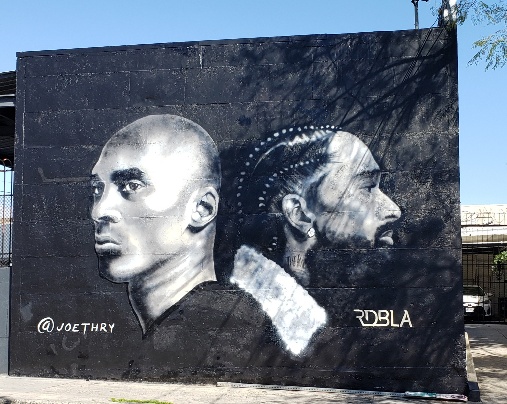
Nipsey, Kobe, and PTSD in Los Angeles

The city had fatigued the soul, and we didn’t even know it. The mileage from here to there. The distance from car to car. The traffic from heart to heart is immeasurable.

There was no screeching stop. Just a gradual slow down on four, five, six lanes of the 405. And every time we tried to reach each other, we were delayed, stopped by the car glass with windows rolled up. The city grew, became more populated. The crowds stumbled onto the boulevards, onto the freeways, into the fast lanes, and carpools. The tires burned rubber. We tried to reach out, but we were blocked by car glass, steel, and aluminum.

The city was brutal beyond a doubt. Beyond reason. The school secretary, mom of four boys killed while driving her small Volkswagen to work. The identical twin struck by a car while riding his bike to school with his brother. The Awaida family, trick-or-treating in Long Beach, mom, dad, 3-year-old son, killed when the car jumped the curb. We tried lighting a candle downtown at Our Lady of The Angels but couldn’t seem to drive ourselves there. The City that we came to inhabit expanded into a County of 4,751 square miles that we had to traverse. It was infinite. So was our love.

We came to L.A. to work. Everyone came to work.

Except the Natives.

And that’s all we got. Work. We tried to find happiness in fleeting moments.

Black Folk stay diverse from the time of their arrival on American shores. Whether they studied in Italy or they have roots in Eritrea. Whether they came from Louisiana, Kentucky, or Tennessee bringing the South to Central Avenue. These things will be eternal. You will see. Because of the memories and the children. Protect the children. At all costs.

The city was deadly beyond reason. And Hollywood didn’t help us understand. We could see it in the faces of the homeless. Their tiredness from lugging their homes around, pushing their homes around. Why were they discarded?

Hollywood did not help us comprehend.

The elementary school teacher, Ms. Crawford, was shot and killed while sitting in her car in the evening. Yetunde Price, the sister of Venus and Serena Williams was murdered in a drive-by shooting. The school employee, Donte Williams, killed while sitting in his car with his girlfriend. The shooting death of 15-year-old, LaMmarrion Upchurch, a dancer with Tommy the Clown, on Manchester Avenue. Shot point blank. Life ends. Shot point blank multiple times. Breathing stops.

The ambulance is late. The security guard is distraught. The family is depressed. We’re finished here. Los Angeles took so much out of us and gave us so little in return. In the end, Kobe tired of the injuries. And Nipsey grew weary of the snitches.

Some men just want to be a dad to their sons and daughters. Las hijas. La Mambacita. To coach them the correct way and offer shelter. We see you in the offices, factories, kitchens. At the shops. On the basketball court. Off the court. In the music studio. That evening at Staples winning the Championship. That night at Staples at the BET’s. The Championship Parade that shut the City down. The funeral procession that shut the City down.

We will remember. Memory is eternal.

-Poetic non-fiction by Audrey Shipp

Cool Black Friend

“Cool Black Friend”

By Audrey Shipp


“Nothin’ from nothin’ leaves nothin’

You gotta have somethin’ if you wanna be with me”

 (“Nothing from Nothing,” Billy Preston)


“You ain’t got to be rich to talk to Gucci, but you got to be part of something

 Ain’t nobody play no pro ball or nothing? Ain’t nobody got nothing?”

(“At Least a M,” Gucci Mane, Mike Will Made It, Zaytoven)


At nine-percent of the city’s population and falling, living in multifarious communities throughout the City and County, Blacks in L.A. have numerous opportunities to be the “Cool Black Friend.”  Opportunities abound on city streets, on school and college campuses, in the workplace, on Hollywood screens, in the music industry, and at the club.  Possibilities are plentiful amongst a myriad of ethnic groups but especially amongst the power majority – White/Euro-Americans, whom as Michael Eric Dyson correctly notes, Blacks have been “reading” for centuries for our own survival–and amongst Latino communities of Mexican and Central American heritage who are the majority culture in once overwhelmingly-African-American South L.A.  Having created the philosophy of cool on U.S. terrain, and having created that framework despite the nothingness of their former condition as chattel property, there is little wonder that Blacks are selected as the Cool Black Friend.  An anomaly, perhaps, given that the deculturalization process for the enslaved involved the “uprooting from land” and targeted the elimination of language, cultural practices, and family ties.  Yet Black history in America is a history of resistance and the creating of something out of nothing.  Railroads invisible to the eye.  Churches in a land that denied them literacy and the bible.  Schools and universities before their freedom was even granted.  Resistance to empire — an acumen for the precise where and when in political movements — that white Liberals cling to today.

In the nation at large, and following the era in which African Americans were forced to take up European musical instruments and play for their enslavers, the Cool Black Friend has existed in music since the era when Whites visited segregated black clubs in locations such as Harlem or Chicago’s South Side.  For the visitor, these excursions were undoubtedly a positive if one had a black connection who could facilitate entrance to a musical venue.  And today, if a non-black musician or singer performs a type of music with African rhythm or African-American intonations, it is advantageous to be chums with a black performer who can give you credence.

Sports abound with Cool Black Friends.  We see this especially on university campuses with huge endowments and top tier sports programs where the student body may be comprised of few African Americans, but the sports team has a large number of Cool Black Friends leading the university to NCAA victory and its resultant monetary gains for coaches, administrators, and the like while excluding the players themselves.  High five to the Cool Black Friend when he or she scores.  Professional athletics are more of a mixed bag, depending on the sport.  Cool Black Friends generate billions of dollars in stadium expansions, advertising, broadcasting, and ticket sales, especially during finals when corporations and the wealthy might buy out front row seats at market price for five thousand dollars (or resale $50K) to watch Black athletes take the spectators’ team to a win.  High five on that.  Yet some sports, such as football with its 70% black players, 25% black quarterbacks, or tennis which has consistently and sporadically (to use an oxymoron) had a lump in its throat regarding the assertive, pro-black, female athleticism of Venus and Serena Williams, or golf which tried to play the token card with Tiger Woods but had to do so only half-heartedly given that athlete’s ambivalence about his own political power, show no interest in white liberal chumminess.

In some cases, having sex with a Cool Black Friend can result in the creation of the longest-running reality show to date in the U.S.  And even though the relationship that spurred that sex tape may sputter and fizzle, the Cool Black Friendship may be seen as a winning formula if the celebrity and her insecure entourage have no marketable talents of their own.  Thus, the formula must be repeated and replicated because, of course, Black Americans have a history of creating something out of nothing.  Aren’t these the people who following Nixon’s questioning their ability to survive another 500 years in the U.S., who after that same President’s statement in the 1970’s that they would only survive if the best ones were inbred, and amidst allegations in the 1980’s of CIA support for Central American counter-revolutionaries that led to dumping cocaine into the hood to fund the Contras and further destroy the black family while fueling the street-to-prison pipeline, turned the dregs of that historical experience into a musical genre?  Trap Music aside, some black friends are simply an insinuation.  By getting butt implants or pumping up one’s lips, it’s possible to allude to a Cool Black Friend 24/7, even when he/she may not be in one’s presence.

In the United States, which has raced with Russia in building approximately 15,000 nuclear weapons, the detonation of 100 of which would block the earth’s sunlight.  The U.S. with the world’s largest number of incarcerated people, 40% of whom are Black, although Blacks are only 13% of the population.  The U.S. which is 5% of the world’s population, yet uses 24% of its energy and is ranked the second largest carbon dioxide producer. A country comfortable with the notion that white wealth is 13 times that of Blacks and Latinos. Yet, living in the Empire, and aware of the disproportionate distortions of day to day life, when Blacks shout, “Black Lives Matter,” “All Lives Matter” is, at times, the rejoinder of Euro-Americans.  With the latter, in this instance, showing scant knowledge of how call and response functions, the question to be pondered is where in the makeup of the Empire is the message “All Lives Matter” being communicated.  Whites live in the Nation.  Blacks, overwhelmingly, live in the Empire.  Even though news networks, public relations firms, and advertisers have recently put their own spin on the word “matter,” so that mileage, insurance, and happiness “matter,” the original proclamation endures.

In these circumstances and during his two terms in office, perhaps President Obama was the ultimate Cool Black Friend.  His presence allowed the United States to look progressive, as if it had overcome its racial differences, as if tolerance were the norm.  He brought Black cool to the nation and the imperial Oval Office. In a geographical world region founded on settler colonialism, Obama inherited the continental — North, Central, and South American — desire of political leaders to have it both ways – to pillage while appearing benign.  In the U.S., the liberal establishment clung to its belief in a palatable nation in which we could maintain our wasteful, consumerist lifestyle, hopefully come together as one, bridge the inherent conflict in maintaining a huge military budget, while supposedly being a beacon to the world of harmonious progress.  In his role as President, Obama had to set the course for both the nation and the empire, but like many imperial leaders, he overlooked the plight of some of his colonial subjects – amongst others, Blacks themselves, who, as inhabitants of the Empire, were seeking a liberator and have scant need for Cool Black Friends because we are our own Cool Black Friends.