Kendrick Lamar, LA Street Culture, and Memoir Writing

During the week of the Kendrick Lamar Pop Out Concert scheduled for Juneteenth in Inglewood, I was busy reviewing my research on the history of Watts. Watts figures in the penultimate chapter of the hybrid memoir I am writing because I owned a home (or a few mortgages) for five years – 2004 until 2009 — in that unincorporated area of Los Angeles. Since I am mixing the history of Los Angeles with my own personal experience as a writer in this city, I knew that in writing about Watts I needed to include some history on the Watts Uprising of 1965. Both the research in my manuscript and my statements here draw heavily on the article by Alex Alonso titled “Out of the Void: Street Gangs in Black Los Angeles.”

The Watts riots of 1965 that were sparked by police officers using excessive force on a Black family during a traffic stop were pivotal in the history of street gangs in Los Angeles. After six days of riots that left thirty-four people dead, L.A.’s rival gangs focused on unity and the ability to work together. And they were successful during a three-year period.

 At the Pop Out concert, Kendrick and others reflected on his concert’s ability to draw rival gangs and various other participants together to celebrate the Juneteenth holiday commemorating the end of Black enslavement. But why gangs? And how do gangs figure into the history of the City of Compton and greater Los Angeles?

As Alonso clearly delineates, Black gangs in Los Angeles developed as a reaction to the white racism that was fundamental in founding this country. As Black migrants left the segregated South and their numbers grew in the rapidly industrializing Los Angeles of the 1940’s, Black residents sought homes beyond the Central Avenue corridor to which they were limited by racially restrictive covenants. The KKK and white teenage hate groups like the Spook Hunters organized to keep Black residents from moving into predominantly white parts of South LA and adjacent cities such as Downey, Compton, Lynwood, and South Gate. Black teens formed their own clubs in order to protect their neighborhoods and combat the white violence being perpetuated against them and their families.

Over the years leading up to the Watts Uprising, South L.A. and cities like Compton became increasingly Black resulting in little need for these groups of Black youths. Yet the formations remained within the deteriorating political and socioeconomic environment of the era, and many of the Black gangs began to engage in Black-on-Black violence. L.A.’s Crips and Bloods gangs filled the void left by former street clubs that had engaged in the positive street behavior which initially resisted white racism and then advocated for Black power. And street violence began to mirror Black socioeconomics as gangs on the Eastside battled with the more upwardly mobile Westside gangs.

Black gangs in L.A. have always been connected to politics – initially, the politics of racism, and later the politics of the Black Panther Party and the revolutionary uprisings in Central America. Regarding the BPP, Alprentice “Bunchy” Carter who was president of the LA-based Black Panther Party was also a member of the Slausons gang. Carter and BPP member John Huggins were targets of the FBI’s counterintelligence agency COINTELPRO, and they were both killed at UCLA’s Campbell Hall in 1969. After COINTELPRO decimated L.A.’s Black Power Movement, the behavior of street gangs became “self-genocidal” in nature.

These “self-genocidal” tendencies broadened in scope during the time of revolutionary upheaval in Central America. Alonso states that between 1979 and 1988, there were more than 2,994 gang-related murders in L.A., and these occurred when the US Government was allegedly involved in facilitating the distribution of crack cocaine amongst Black gangs in order to fund the CONTRA counterrevolutionaries in Nicaragua – further proof of just how intertwined Black gangs are in the politics of not only L.A., but the nation.

When Kendrick Lamar beams onstage about members of rival gangs coming together to join him at his concert, there are layers of culture, history and politics that deserve to be reckoned with. Black South L.A. formed in resistance to white racism, and California dreamin has rarely been our state of mind no matter how many sunny afternoons fill a calendar year. So many dreams have passed on, packed up and left, been either locked up or tragically shot down. And like Kendrick said, Black L.A. hasn’t been the same since…

Unlike other cities, greater Los Angeles, like its Eastside, has demanded that its rappers stay true to the streets or connected to their working-class roots in ways that other cities have not.  That is part of LA street culture and culture, as evidenced by Kendrick’s stage, is something we live in the moment without rationalizing about history and politics. Until we must. And then we analyze to discern if the social connections are real, partial, or just make believe.

How much of the history and politics of street gangs in L.A. is conscious to Kendrick Lamar and those who celebrated both on and offstage with him on Juneteenth? That is a question I can’t answer. But I can reflect on the history and politics of this topic in my memoir which I must hastily get back to writing.

Lost in Los Angeles

I center the beginning of my memoir on my feelings of alienation from Los Angeles during my youth. Given the reflective impulse of memoir, I now realize that one reason I felt alienated from my city of birth was because I didn’t know its hidden history. Yet, history, whether in written or oral form, can be boundless, especially when the focus is a major city. I wanted to know the history of the land because one of my goals as I write my memoir, is to invite the land to speak. With that goal in mind, I decided to research the relationship Native Americans have with the land. I found some clues in a couple of articles.

I’ve passed La Ballona Wetlands in West Los Angeles countless times. Almost always, it’s during a drive to the South Bay when I take Jefferson Boulevard west. La Ballona is 577 square acres of grassy wetlands you encounter before the turn left on Vista del Mar results in expansive views of the sandy beaches and rolling waves of the Pacific Ocean. A sign indicates the wetlands are an ecological reserve. Yet, I had no idea that this area was also a former community and sacred burial ground of the Tongva Natives — commonly referred to as the Gabrieliños. The research of Seetha N. Reddy and John G. Douglass – “Native Californian Persistence and Transformation in the Colonial Los Angeles Basin, Southern California” –wasn’t replete with information on the Tongva’s relationship to nature, but the writers did state that the Tongva polished, painted, and adorned pine trees as part of a burial ritual at the Ballona site. The Natives made offerings of plant foods that they burned in baskets during burial ceremonies as well. The scant information I found demonstrated the intimate relationship between nature and this Indigenous group who were historically second only to the Chumash in regard to wealth, population, and power. With its distance from El Pueblo in what is now downtown Los Angeles, La Ballona was a living space that allowed the Tongva to escape the governance of the Spanish. Distance was preferable because after the arrival of the Spanish – who viewed them either as laborers or souls to be saved – the Indigenous lifestyles of the Tongva were disrupted in just one generation.

Before you even view the beach, the sense of vastness that hangs over the Pacific Ocean is something you sense at La Ballona. I wasn’t totally surprised to learn that the area was sacred Indigenous land. It has a distinct aura that marks it as special, as do other locations in Southern California such as the Hollywood Hills, Chino Hills, and Palos Verdes.

I gained additional insights about the Tongva people from Jon Mcvey Erlandson’s article titled “The Making of Chumash Tradition: Replies to Haley and Wilcoxon.” His writing focuses primarily on the Chumash Natives, but I learned the Tongva prophet Chinigchinich was born on the territory that is now Cal State Long Beach. In other words, the university campus is also sacred Native territory. The most sacred. The original name of the site is Puvungna which means “where all things come together.” And as recently as 1972, archeologists discovered a Native American burial site on university grounds.

Land considered holy for the Chumash includes Point Conception in Santa Barbara. Yes, the famous Point Conception that is a major geographical site for meteorologists charged with delivering our daily and weekly weather forecasts. The Chumash refer to this area as the Western Gate and they believe the dead pass to the afterworld here. They hold sacred the idea that there was “a land of the dead across the sea to the west.”

Erlandson’s article tells us the idea of individual ownership of land was a foreign concept to Native Americans. Quite an irony in a state like California which has some of the most expensive land parcels in the country, especially when the real estate is on the coast. I didn’t glean a ton of information about nature from this second article, but I was able to infer that the Natives, who have inhabited Southern California for at least 11,000 years, didn’t have the materialistic relationship to the land that characterizes current economic practices.

So, what was my major takeaway? I learned to differentiate the city constructed by humans – with its miles of pavement, glass skyscrapers, freeways, streetlights, and endless rows of homes — from the land. I came to realize that the two are distinct entities. And it’s the city – whether under Spanish, Mexican, or US governance – that has imposed its rules and regulations regarding the land on top of Native beliefs. Once I got a clearer idea of how the Tongva and Chumash viewed the land and how they held it sacred, a lot more made sense. Yes, I sensed when I was in the vicinity of La Ballona that there was something special about the area. Or when I viewed Chino Hills while driving south on the 71, I felt in awe of the serenity and sense of balance on the land there. Undoubtedly, I have felt alienated from the City of Los Angeles. I still am. But I’ve learned to love the land and to embrace it as it has embraced me. And that is one major contradiction about living in Los Angeles – how one can feel alienated from a city that can be downright ruthless while loving a land that is quite welcoming.

A Dizzy-Tizzy Day at LA Festival of Books

I prepared well in advance for the Saturday book panel titled Politics and History: Roots of Black Resistance. Like last year, I purchased my tickets the night before, printed out a map of the USC campus, and felt certain I could find the appropriate halls or auditoriums. Undeterred by an infection that caused me to go to urgent care at 9 a.m. that same morning, I took my prescribed antibiotics and set off for downtown LA.

As I drove south on Vermont Boulevard near the campus, I noticed bumper-to-bumper traffic inching north towards Jefferson. Yet, I felt confident that my entry at the parking gate on Exposition would afford me swift entrance – as it did last year — so that I could make my first panel at 1:30 p.m. After I pulled up to the booth, the attendant informed me that I needed a reservation for parking to enter the campus but that I could proceed north on Vermont to access parking at the Jefferson lot. Having already seen the snarl of traffic on Vermont, I opted to go south and check for parking at the Museum of Natural History. Full. Same for the Coliseum where I saw crowds and more crowds of students, alumni, friends, and families exiting in USC gear. From that point of disillusionment, I drove for more than an hour in a series of loops around the campus that included passing the Shrine Auditorium. Full. I even checked to see if either the Automobile Club building (quinceañera in progress at the cathedral across the street) or the parking lot at LA Trade Tech might be open.

Defeated, thirsty and famished, my body now craved food and drink. I decided to let the land instead of the city decide my fate and thus, resolved to head to the beach for victuals. Since I had to pass Exposition Boulevard to proceed west, I gave the original parking gate a final try. The same attendant, appearing as tired and stressed as I was, informed me that now there were spaces. With that, my day at the LA Festival of Books began. Finally. In earnest.

Having missed my first panel, I joined the flow of the crowds and walked around browsing amongst the booths until the panel Los Angeles on the Page: Memoirs & Stories was scheduled to start at 4:30.

I enjoyed this insightful panel that included David Kipen, D.J. Waldie, Zev Yaroslavky, and Jim Newton. I must admit that my first reaction when I registered the night before was to wonder why a city as diverse as Los Angeles had a panel on memoir that was made up of three White male writers and a White male moderator.

During the memoir panel, two ideas in particular resonated with me (no, I didn’t resonate with them) during this panel. The first was from Waldie who emphasized how L.A. has a hazy, uncertain history with no clear line from the past until now which makes it a city uniquely subject to mythology. It is layered in past events and traditions that include Spanish, Mexican, and US history. I will add “Native American,” especially Tongva and Chumash, to that mix.

In addition, Zev Yaroslavsky and D.J. Waldie discussed how a lack of primary sources such as letters and diaries will make it difficult for biographers and historians to find documentation and do research in the future, given our new digital lifestyles. The point here isn’t that digital creations aren’t primary sources. They are. They are just more difficult to access.

And like that, the day was done. Thanks to the writers, the readers, the institutions that made the day possible. Thanks to the city and the land.

Cop Brutality: @Memphis and Nigeria’s #EndSARS

“But somehow we survive

severance, deprivation, loss

Patrols uncoil along the asphalt dark

hissing their menace to our lives,

most cruel, all our land is scarred with terror,

rendered unlovely and unlovable;

sundered are we and all our passionate surrender

but somehow tenderness survives.”


-Dennis Brutus (from “Somehow we survive”)


MY MEMPHIS TRAUMA REVOLVES AROUND THE UNIVERSE OF WILEY BENTON WHO WAS ONE OF TWELVE CHLDREN BORN TO MY MATERNAL GREAT GRANDPARENTS, BUD AND LETTIE BERNETTE BENTON.  THE BROTHER OF MY GRANDMOTHER, DOLLIE, A YOUNG WILEY LEFT HOME TO RUN AN ERRAND, ONE DAY IN 1930’s MEMPHIS. HE WALKED IN A PART OF THE CITY WHERE HOUSES FADED INTO TREES AND WHERE THE PAVEMENT DRIFTED TO DIRT ROAD, CHANGED TO LEAVES AND BRANCHES UNDERFOOT, SNAPPING AND BREAKING BENEATH HIS FOOTSTEPS. HOURS, DAYS LATER, WILEY NEVER RETURNED HOME. NEVER. HIS WAS THE EMPTY PLATE AT EVERY FAMILY REUNION IN MEMPHIS AND DURING ALL THE CHRISTMAS DINNERS OF HIS SIBLINGS IN CHICAGO AND LOS ANGELES.

on January 7, 2023 police officers pulled over TYRE NICHOLS for alleged reckless driving. what should have been a routine stop turned instead to his battle with death as five police officers beat and tased the 29-year-old to death. TYRE, father to a four-year old, was a skater who had a website called “THIS CALIFORNIA KID” documenting his skating life in sacramento. he had come to memphis during the pandemic to live with his MOM and was working with his STEPFATHER at fedex. his killers were members of the memphis police unit called scorpion (street crimes operation to restore peace in our neighborhoods) that the department formed in november 2021. following the murder of TYRE, the unit was disbanded.

in nigeria, there had been years of complaints about the police unit called sars (special anti-robbery squad). authorities formed the unit in lagos in the early 1990’s, and later it was expanded as part of a national police strategy. nigerian citizens complained of being arrested, detained, and tortured by sars officers.  two incidents in 2020 set off national and international protests against the police unit – an arrested MAN falling off a police vehicle in early october in delta state who onlookers presumed dead and then police killing protestor, JIMOH ISIAKA, on october 10 in oyo state. a few days after those two incidents and their subsequent protests, the police replaced sars with a new swat unit.

INDULGING IN HER ROLE AS THE BEST SOUL FOOD CHEF OF THE TWO MEMPHIS SIBLINGS THAT MIGRATED TO L.A., MY AUNTIE TILLIE COOKED CHRISTMAS DINNER AT HER HOUSE EVERY YEAR. TILLIE (HAYDEE MAE) WAS AN OLDER SISTER OF MY GRANDMOTHER. AS THE TWO OF THEM TALKED ABOUT MUNDANE INCIDENTS OF DAILY LIFE, THEIR CONVERSATION MEANDERED TOWARDS MEMPHIS MEMORY WHEREUPON THEY EVOKED THE EMPTY PLATE OF THEIR BROTHER WILEY. AND FROM WILEY, MY AUNT TILLIE ALWAYS SHIFTED TO STORIES OF HER LATE HUSBAND, DAVID, WHO DIED A YOUNG MAN YEARS BEFORE I WAS EVER ABLE TO MEET HIM. DAVID SERVED IN THE SEGREGATED MILITARY OF THE UNITED STATES, AND HIS IMAGE, WITH HIM IN UNIFORM, STARED OUT AT US FROM AN END TABLE IN MY AUNT’S LIVING ROOM. WITHOUT FAIL, AT SOME POINT IN THE EVENING, AUNT TILLIE WOULD BEND OVER HER WOODEN RECORD PLAYER, PICK UP THE NEEDLE AND PLACE IT ON DINAH WASHINGTON’S LP JUST AT THE LINE WHERE “A COTTAGE FOR SALE” BEGINS.

the five officers who killed TYRE NICHOLS in memphis were fired. as the nation goes through these cycles of police abuse and firings, we know that firing officers doesn’t end our colonial status as Black people within a system of white supremacy. Journalist CHRIS HEDGES recently stated that the “military and police forces in the u.s. function as armies of occupation” stabilizing corporate colonialism. despite the five officers being black, they derive their agency by ensuring the social system functions for a business-as-usual economics that benefits the few. within capitalism, the “representationalist” aspect of identity politics, to quote the late GLEN FORD, hasn’t saved us from losing forty percent of our wealth since 2008, nor from being forty percent of the nation’s homeless while accounting for only fourteen percent of the population.

at a press conference in memphis, police officials said, “…”


despite protests across nigeria over police brutality, police and hired thugs continued to kill PROTESTORS. during the october 2020 protests in lagos at the lekki toll gate, soldiers attempted to restore order. order in nigeria includes maintaining control over crude petroleum – a crucial global resource and the nation’s largest export; one percent of the population owns eighty percent of the nation’s oil wealth. despite PROTESTORS waving the nigerian flag and singing the national anthem, soldiers stormed and shot at them. the military killed at least forty-eight PEOPLE and another ninety-six CORPSES were later found.

at a news conference in lagos, authorities promised, “…”


THE MUSIC PLAYING, AUNTIE STOOD IN HER DINING ROOM, RAISED THE SCOTCH AND COKE TO HER LIPS, AND TOOK A SIP. HER LIPSTICK LEFT A RED STAIN ON THE GLASS. SHE POINTED TO HER FOOD PREPARED MEMPHIS STYLE AND SAID, “YES, DAVID LOVED MY COOKING.” MY GRANDMOTHER, SISTER TO BOTH AUNT TILLIE AND THEIR DISAPPERARED BROTHER, WILEY BENTON, SMILED. I REALIZE NOW THAT MY AUNT COOKED NOT JUST FOR THE LIVING, BUT FOR THOSE WHO HAD PASSED AWAY.

MAKING WAY FOR US TO EAT, AUNTIE WALKED TO THE KITCHEN AND RETURNED WITH PLATES SHE THEN PUT ON THE TABLE. THERE WERE DISHES FOR EVERYONE AND A FEW PLATES THAT WOULD PASS THE NIGHT EMPTY. NOTICING HER SONG HAD REACHED ITS END, MY AUNT BENT OVER THE WOODEN RECORD PLAYER, PICKED UP THE NEEDLE, AND PLACED IT BACK AT THE BEGINNIG OF DINAH WASHINGTON’S SONG.

WITH HORNS AND BASS PROPELLING HER FORWARD, DINAH VOCALIZED, “FROM EVERY SINGLE WINDOW, I SEE YOUR FACE. BUT WHEN I REACH THAT WINDOW, THERE’S

EMPTY


SPACE.”


SOURCES

The accounts of police brutality directed at Tyre Nichols are from:

“Woke Imperialism” by Chris Hedges in The Chris Hedges Report” (San Francisco: Substack, Feb 5, 2023)

“We’re not done: end of Scorpion Unit after Tyre Nichols death is first step, protestors say” by Edwin Rios in The Guardian (New York: Jan 29, 2023)

“Colonial-Capitalist Fascism and its Deadly Outcome: The State Murder of Tortuguita in Atlanta and Tyre Nichols in Memphis Are Inextricably Linked” by Black Alliance for Peace Atlanta in Black Agenda Report (USA: Feb 1 2023)

The accounts of police brutality in Nigeria are from “The massacre at the Lekki Toll Gate” by Femi Falana SAN in The Guardian Nigeria (Lagos: Nov 24 2021)

The statistic on Nigeria’s oil wealth is from “Imperialism, dependence, development: Legacies of colonialism in Africa” by Lee Wengraf in International Socialist Review (Chicago: Center for Economic Research and Social Change, Issue 103, Winter 2016-17)
The Incalculable Costs of California’s Mass Shootings

My closest confrontation with gun gunfire came at the end of what started out a normal workday. Decades back when my seventeen years of teaching middle school left me feeling that the word I said most often was “no” – with my own kids at home and with the middle schoolers at work, — I drove one afternoon from my job at Adams Middle School that was just south of downtown Los Angeles to Jefferson High School in South Central. I had an afterschool interview with a Jefferson administrator about a possible transfer to their campus. The atmosphere on Central Avenue that day included the typical L.A. weather that hinders deep thought – the clear blue skies, the glaring sunlight that bounces off cars’ rear windshields and back bumpers – the weather that inspires you to come outside, get out of the house; but once you are out, you’re greeted by the pay-to-play society that is America.

As I drove near the school parking lot towards the dismissal chaos that happens once a school bell rings at the end of the day, gunshots rang out in front of me from the left side of the street. Students scattered. School staff on supervision ducked down. I noticed a young person on the right side of the street who appeared to have been shot being pulled into a black car. Like other cars nearby, I made a U-turn on the tight residential street and headed in the opposite direction. I drove away from the chaos of that afternoon.

Fast forward to contemporary California – the state with the nation’s strictest gun laws — and the string of mass shootings that have occurred in January 2023.[i] One of the first was in the City of Monterey Park in San Gabriel Valley – not San Fernando, but the other valley; the valley popular media chooses to forget. A working-class region – San Gabriel Valley lacks the media chic of an adjacent Calabasas; and, geographically, instead of leading to the lush vegetation surrounding cities near Santa Barbara, it drifts into the dryness of Palm Springs. At a dance studio he frequented in the Chinatown area of Monterey Park, 72-year-old, Huu Can Tran, murdered eleven people – My My Nhan, Lilian Li, Xiujuan Yu, Muoi Dai Ung, Hongying Jian, Yu Lun Kao, Chia Ling Yau, Valentino Marcos Alvero, Wen Tau Yu, Ming Wei Ma, and Diana Man Ling Tom – ages 57-72. He also injured nine others. It was January 21, the eve of the Chinese Lunar New Year. Following the shooting, Tran shot and killed himself during a standoff with police in the city of Torrance.

Next, on January 23 in the northern California city of Half Moon Bay, sixty-six-year-old Chunli Zhao, a farmworker, shot and killed seven of his co-workers – Marciano Martinez Jimenez, Jose Romero Perez, Aixiang Zhang, Zhishen Liu, Qizhong Cheng, Jingzhi Lu, and Yetao Bing – ages 43-74. He also wounded one other person. It appears the shooter was upset because his supervisor requested he pay one hundred dollars for damage to a forklift.[ii] Zhao later drove to a police station where he was taken into custody.

On that same day in Oakland, 18-year-old Mario Navarro was killed and four people injured while filming a music video. The shooter has not been apprehended.

Then, on January 28 in the Los Angeles neighborhood of Beverly Crest,[iii] adjacent to Beverly Hills, Nenah Davis, Destiny Sims, and Iyana Hutton, ages 26-33, were killed and four others wounded outside a party being held at a home being used as a short-term rental.

In a country where guns outnumber people, the US is averaging six hundred mass shootings per year. That’s more than the human mind and human emotions can keep up with. The pace dehumanizes not just the dead, but the living. The 338 million people who make up the U.S. own more than 400 million guns.[iv] That’s domestic gun ownership – sans cops and military. We are five percent of the world’s population, and we own forty-two percent of the world’s guns.[v] We may not be ready to end world hunger, stop climate change, or spread democracy across the globe. But we are ready to kill. Each other. Unfortunately, at a certain point the mass shootings stop being a shock in a society in which we are adversaries of ourselves. Everyone is a potential threat, a lurking enemy.

I may have tired of saying “no” to middle schoolers and my own kids, but where is the “no” to corporate gun trafficking in the U.S.? How are parents supposed to discipline youth on the topic of gun ownership within the capitalist anarchy of our society? Ours is a society that doesn’t say “no” to indulgence – especially not the indulgence of guns.

Back in time, at the shooting that occurred before my job interview, I circled the blocks adjacent to the high school a few times. Holding the steering wheel with both hands, I took a few deep breaths and drove back to the school to see if the perimeter appeared safe. I passed by. I then made a big loop around the campus by driving a few more blocks before finally entering the school parking lot to go to the interview. Sitting at a desk with the administrator, we discussed the shooting and then our conversation shifted to facts about the school.

When I finally transferred to a high school, it wasn’t Jefferson. I chose another location, but I did teach a Saturday enrichment program on their campus some months after the shooting. I was never afraid to be amongst the students there. We read, wrote, conversed. And like high school youth in many cities across the U.S. who are filled with expectations about their future lives, they eventually applied for college.

[i] Beckett, Lois and Levin, Sam. “Eight Days, and 25 dead: California Shaken by string of mass shootings.” The Guardian. 25 Jan 2023.

[ii] Turner, Austin. “Half Moon Bay: DA confirms report that shooter was triggered by $100 equipment bill.” Santa Cruz Sentinel. 27 Jan 2023.

[iii] Associated Press. “Police say three dead, four hurt in latest California shooting.” The Guardian. 28 Jan 2023.

[iv] Horsey, David. “More than 400 million guns, from sea to shining sea.” The Seattle Times.” 20 May 2022.

[v] Harrison, Pricey. “The U.S. has approximately 5% of the world’s population and 42% of civilian gun ownership.” PolitiFact. 15 February 2018

Disparaging Black-American Culture in a Vague Economy

(This essay was originally published on Medium.com on August 31, 2018.)

(A response to “Black American Culture and the Racial Wealth Gap”)

In his recent article, “Black American Culture and the Racial Wealth Gap,[i] Columbia undergrad Coleman Hughes argues that activities which he regards as Black-American cultural traits such as conspicuous consumption and a lack of financial education result in Whites having economic wealth that is ten times that of Blacks. Hughes believes “there are certain elements of black American culture that, if changed would allow blacks to amass wealth.” Because these elements are held by both White- and Asian-Americans, central to Hughes analysis of culture and economy is the notion that the vague entity he refers to as “white culture” is superior to that of Blacks. His assumption of white superiority is made evident in the dichotomy he constructs when referring to Irish-Americans and German-American Jews as “formerly lagging ethnic groups” who embraced so-called dominant White cultural traits and became successful. In Hughes analysis it is cultures, not social classes, that engage in certain practices that lead to economic success.

Hughes does indeed approximate a truth when referring to how culture can beset us with limitations, because he himself is an example of precisely that. He adroitly proves his limitations as an American scholar who inserts himself into an academic arena to analyze economics with the pretense that Marxist analysis of economy does not exist. As a scholar living within the depoliticized social and cultural sphere of the United States, he seems unaware of how Marxist analysis of society is able to flourish both in the academy and within the broader cultures of industrialized Europe and Latin America while not being able to do so here. Hughes is oblivious to the forces within U.S. society which have both co-opted social movements that advocate for economic change and depoliticized the populace such that there is almost no critique of the capitalist economic system. By limiting himself to the cultural confines of U.S. society, Hughes establishes two misconceptions. The first is apparent in his title “Black American Culture and the Racial Wealth Gap” in which he readily ignores the most significant analysis of modern economy done by Karl Marx and proceeds to argue that “self-defeating behaviors” in “black culture” account for Blacks having less wealth than Whites. A second misconception is his use of vague terms such as “the academic Left” and “the Left.” While the term “academic Left” may be fairly precise in the U.S. context given that Marxist analysis is accepted within the confines of the American university, “the Left” when used to refer to politics in the broader society is a nebulous term. What is this Left and who are its members? Would these be Liberal Democrats who, as economic Liberals, advocate the same laissez faire capitalism that the American Right espouses? U.S. Democrats would hardly be considered “the Left” in the industrialized societies of Europe and Latin America. Or is Hughes as limited in his provincial U.S. intellectualism as Blacks are limited by their purse strings in that same society?

According to Hughes, if small-b, black culture were to change, there would be an end to small-b, black poverty. But what is the Black culture he refers to? He is disinclined to refer to small-b blacks as African Americans. In his essay African Americans are mere appendages to the broader Euro-American culture. Would the term “African American” necessitate the writer having to discern how colonialism functions in a capitalist society and how economic and cultural dominance are intertwined? Hughes states that “Asian-Americans…are on track to become wealthier than whites.” How does the fact that Asian-Americans are not a colonized people (i.e., Native Americans, African Americans, Puerto Ricans, Mexican Americans, and Hawaiians) factor into their success? As an immigrant group that for the most part did not suffer conquest, many Asian American cultural groups have unhampered access to Confucian teachings that equate education to godliness. On the other hand, White enslavers forbade the African-American enslaved to read books and when they did, those books did not connect them to the Caribbean culture Hughes praises nor to African culture. Furthermore, various cultural groups within the United States, such as Korean Americans, have financial institutions in their U.S. communities that link them to financial assets in their highly-industrialized homelands. Yet in Hughes worldview, the dominant culture exerts no control over marginalized cultural groups and treats them all the same. But if that were the case, why then the anecdotal evidence showing Asian American parents push their children to study engineering, the sciences, etc. to circumvent discrimination in professions based on the liberal arts?

Hughes claims “a nation’s wealth has more to do with the economic system it adopts and the set of skills its citizens possess.” But just like surplus value in a capitalist economy, the exact economic system he refers to remains an unstated allusion. Capitalism is the dominant global economic system; yet, Hughes dares not call it by name because that would require reference to its arch critic, Karl Marx. If, as he states, wealth is indeed based only on the current economic system (capitalism) and the skills of its citizens, why is U.S. capitalism wealthier than that of not only Nigeria or Mexico, but also of Great Britain and Finland which both have lower per capita gross domestic product rates than the U.S.? Is this where culture, referred to in Hughes’ title, becomes a dominant factor? Yet European societies have experienced intense levels of industrialization. Perhaps Europeans lack the skills to produce the American products sold by apple, Nike, and Mattel. But Americans no longer manufacture most American consumer goods now that U.S. companies outsource production internationally seeking cheap labor to enrich U.S. CEO’s and leaving the U.S. worker deskilled.

In his negation of racial discrimination as delineated by Ibram X. Kendi and his repudiation of a call for justice through reparations as advocated by Ta-Nehisi Coates, Hughes argues solely for a form of self-help to end Black poverty. Denigrating any form of reparations for Black Americans, Hughes states “slavery is hardly the root cause of America’s prosperity (because) if it were, we would expect American states that practiced slavery to be richer than those that did not.” Hughes contrasts the wealth in the Northeast of the U.S. with the poverty of the former slave-holding South with no reference to northern industrialization as if the U.S. were still a horse-and-buggy economy. Yet to remain dumbfounded about why a geographical region is not wealthy after its wealth and natural resources have been expropriated is akin to asking why a worker is not wealthy after his labor has been appropriated to create surplus value. Following Hughes argument that cultures, not social classes, engage in certain practices that lead to economic success, he believes entire swathes of “children from one culture may routinely hear phrases like ‘asset diversification,’ ‘mutual fund,’ and ‘inflation rate.’” Yet how ironic that while these terms are supposedly heard by Asian-Americans and Whites regardless of class and despite where they live in the U.S., Hughes remains oblivious as to how wealth can be extracted from a specific region with scant benefit to that region just as wealth can be expropriated from a worker with surplus value going disproportionately to his or her boss, the company, or the corporation that employs that worker

In a capitalist economy the wealthy get wealthier and the poor get poorer according to Marxist analysis. This reality can be seen not only in U.S. society but in the global arena as well. As such, it is not incomprehensible that in the U.S., the groups that started with the least, Native Americans and African Americans, would have minimal economic advantage in a laissez faire capitalist system that added genocide, slavery, racism, and colonialism to the brutal economic system it imposed. Citing “spending patterns” as a direct cause for Black cultural deficiency, Hughes ignores the economic system in which African Americans live as he constructs a false argument that culture determines wealth. In his disregard for the breadth of global, intellectual wealth on the topic of the economy, the writer’s attempt to analyze the circumstances of Black Americans is constricted by the limitations of the dominant, depoliticized, provincial American culture he fetishizes.

How will the circumstances of small-b blacks change according to Hughes given that “no element of culture harms black wealth accrual more directly than spending patterns”? The writer criticizes Blacks ownership of smart phones, at 71 percent, and contrasts it with that of Americans in general, at 62 percent. Ironically, even though Blacks purchase more technology, Hughes concludes Blacks “are ill-suited for success in the information economy.” At the close of his essay, he appears to allude to the fact that the revolution will occur via media as he laments both the “ignorance” of the American “Left” and the “impotence” of “the Right” and emphasizes how the latter cannot help change Black culture because they are “too far from the media channels through which blacks tend to communicate.” If the revolution is going to occur via media, why bemoan the purchasing of smart phones by Black people? If technology in an “information economy” will be used to transform culture in a future with no reparations because the latter “would not address the root causes of black underachievement,” wouldn’t the purchase of smart phones be advantageous? Yet the “information economy” the author refers to exists in the present economic order which is capitalism. And yes, capitalism impels reparations — for Black Folk and all exploited peoples as well.

[i] Hughes, Coleman. “Black American Culture and the Racial Wealth Gap.” Quillette 19 July 2018: 1–11. <https://www.quillette.com/2018/07/19/black-american-culture-and-the-racial-wealth-gap/&gt;

How to Do a Book Reading Like a Jazz Musician

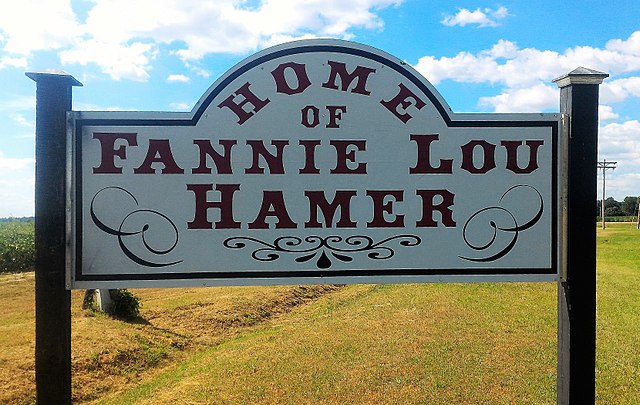
The book, “Mama Fannie,” evolved into a musical instrument as her daughter simultaneously read from the text and addressed the live audience. Jacqueline Hamer Flakes was a guest at the City of Asylum community center in Pittsburgh on January 14. Her presentation was a reading where she shared her new book about her mom, Fannie Lou Hamer. Her reading from the biography was one of the most unforgettable and affectionate I’ve witnessed because Jacqueline Hamer, also known as Cookie, rendered the book a musical instrument – she read a series of short sections, and following each, inspired by memories of her mom, she related her own stories that each narrative in the book motivated her to tell. The result was a splendid and engaging series of riffs on who Fannie Lou Hamer was and how she championed social justice throughout her lifetime. Here is some of what Jacqueline, the daughter, shared:

The chords: Fannie Lou Hamer

The riffs: Born in Montgomery County, Mississippi, Fannie Lou Hamer was a Civil Rights activist and community organizer who resisted white supremacy by working with both the SNCC (Student Nonviolent Coordinating Committee) and the SCLC (Southern Christian Leadership Conference). During her early forties, she visited a doctor to have a cyst removed, and unbeknownst to her, she was given a complete hysterectomy. Unable to bear children, she eventually adopted four girls, and Jacqueline Hamer Flakes, the author of the biography, was one of them.

The chords: Not just 40 acres

The riffs: Black Folk in the U.S. (and globally) have yet to receive reparations for enslavement, but where there is a will, there is a way. Fannie Lou encountered barriers simply trying to buy a home, and when she did finally acquire one, it was firebombed. Along with Maya Angelou and others, she went on to raise money in 1969 to purchase 40 acres in the Mississippi Delta. That land was central to the founding of Fannie’s Freedom Farm Cooperative which she expanded by an additional 640 acres in 1970.

The chords: Africa

The riffs: Fannie Lou was part of a SNCC delegation sent to Conakry, Guinea by Harry Belafonte. The trip in 1964 proved both life changing and inspirational. A child of the segregated US South, her travels in West Africa opened a window to a view of Black people capable of running their own societies.

The chords: Advice

The riffs: “What would Fannie Lou Hamer tell us today?” Jacqueline Hamer responded by saying her mom, the activist and organizer, would tell Black people to get an education. (Fannie had to labor in the cotton fields starting at age six, consequently she only attended school three months out of the year.) She would advise us to go into communities and help others get an education and to pay it forward and pay it back.

The chords: A pot of peas

The riffs: Jacqueline Hamer criticized how authors have written about her mother and built their own books and reputations without really knowing the real Fannie. She said was wonderful that, in the past, writers interviewed Fannie Lou before they wrote about her. But she reminded us that those who didn’t sit with her mom and shell peas, didn’t really know the real Fannie Lou Hamer.

Harriet Tubman, Twitter, and Freedom

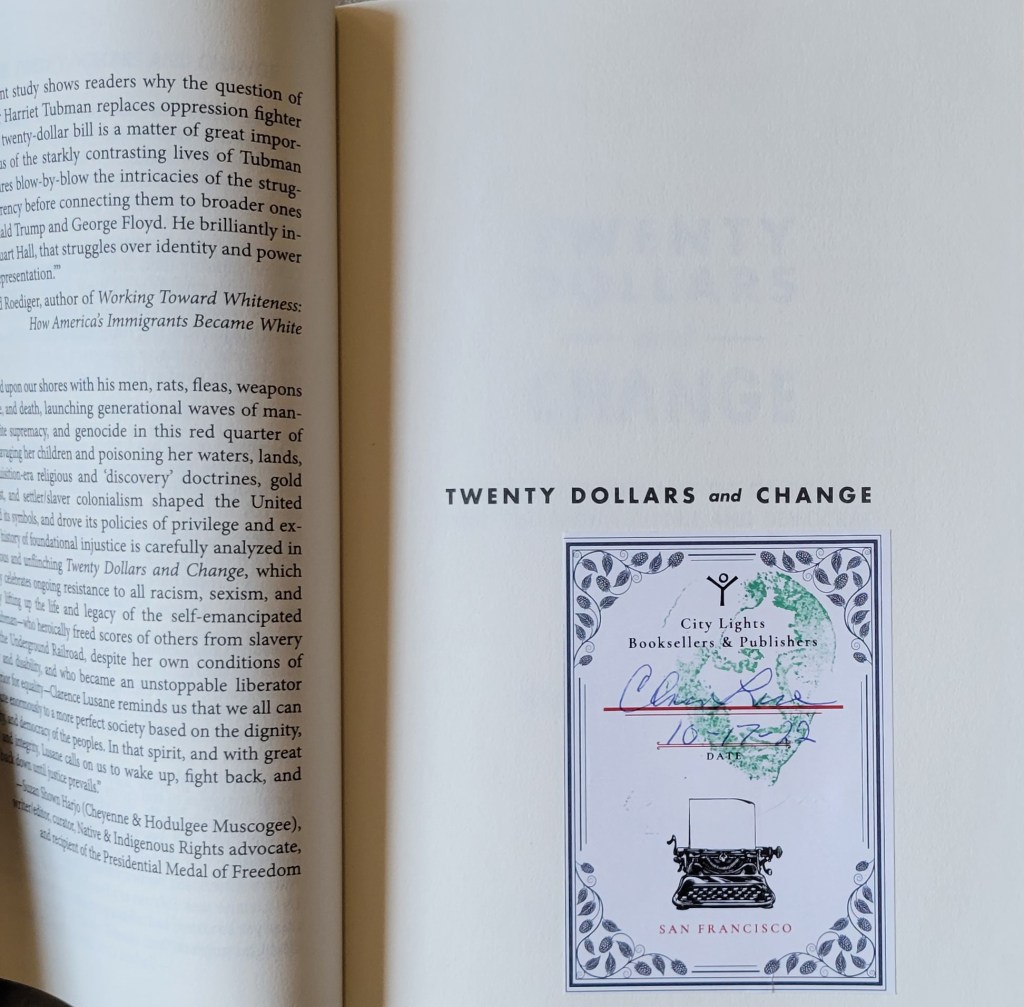
San Francisco’s City Lights Books invited Dr. Clarence Lusane to speak about his new book, Twenty Dollars and Change: Harriet Tubman and the Ongoing Fight for Racial Justice, with moderator, Justin Desmangles. As I watched the livestream on November 21 of this year, the symbolism of Tubman awakened my memory. The cover of Dr. Lusane’s book reminded me that an image of Harriet Tubman had once been my profile picture on twitter.

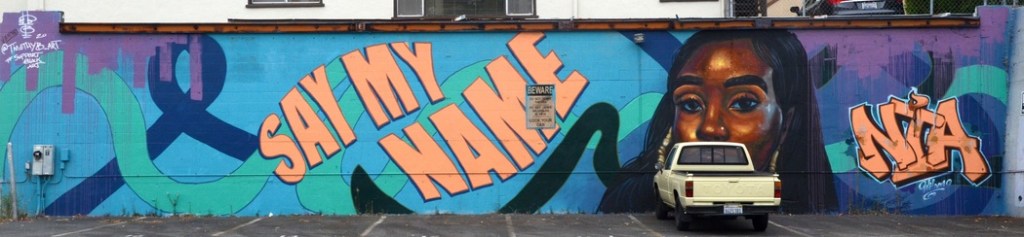
Although I might have forgotten my selection of images for social media, the reasoning and emotions behind the choice were very present. In July 2018, I craved an image that symbolized freedom for my twitter profile pic. Nia Wilson had just been murdered and her sister, Lahtifa, stabbed while they, along with a third sister, Tayisha, waited for a train at an Oakland subway station. The stabbing murder forced me to consider how Black people in the U.S. still were not free. Eighteen-year-old Nia Wilson, a Black woman, was killed by John Lee Cowell, a twenty-seven-year-old White man. Cowell had been on the same train as the sisters prior to the stabbings. And despite his expressing in court his anger about being punched by a Black woman a week prior to the stabbings, and despite his having called another Black woman the N word on a city bus as he fled the crime scene, the murder of Nia Wilson was never ruled a hate crime. For me, the physical and emotional injuries inflicted on the Wilson family, along with the seemingly countless murders of Black people that filled social media from the deaths of Trayvon Martin to Sandra Bland to George Floyd highlighted the colonial nature of Black life in the U.S. The same political and economic forces that had labelled us less than human as they drug us through the Middle Passage, that had forced us to work in bondage with, to date, no compensation, and that had deemed us second-class citizens under fascist Jim Crow were still operational.

Before choosing the Tubman pic for my profile, I’d had so many profile names and pictures during my fourteen years on the social media site that I can’t remember them. After the murder of Nia Wilson, I’d chosen Tubman because as both a runaway and an abolitionist, she symbolized freedom. Freedom from the white supremacy ingrained in capitalism, freedom to be Black and a woman, freedom to make choices about how the Black community in the U.S. chose to live, freedom to find liberatory spaces.

During my years of Twitter usage, I witnessed how the site had been instrumental in several political movements during the early part of this century – the Arab Spring, the Indignados in Spain, Occupy Wall Street, Black Lives Matter, and EndSars in Nigeria. I’d later seen counter-revolution stifle the Arab Spring when authorities began policing social media and jailing activists. In Nigeria government officials froze the bank accounts of protestors or chased them into exile. And in the overdeveloped West, authorities silenced some activists while global capitalism proved itself capable of incorporating liberals from the Indignados, Occupy, and BLM movements into the status quo of electoral politics or career activism. These were activists who had failed to base their protest on the most radical of political demands.

Prior to the Musk takeover of twitter, I’d thought of the social media site as a space where leftists could not only keep up with political developments, but also engage in conscientization and grow in leftist theory. I’d seen the joking statements made by twitter users who said they came to the site as a liberal and ended up an anarchist. Given the political space in which we found ourselves, it’s not surprising that twitter attracted Black activists. It has been a space in which Black nationalists, Pan Africanists, feminists, leftists, and radicals could converge to share ideas and battle in ideology. If Frantz Fanon and Malcolm X advocated the termination of colonialism and human degradation by any means necessary, then twitter appeared one means of doing so.

While I was aware of the contradiction of using a capitalist site like twitter as a leftist political space under the helm of Jack Dorsey, I, like countless others, am even more aware of this insurmountable irony under twitter’s new ownership. Musk’s reactivation of rightwing accounts has resulted in some liberals and radicals abandoning the site. If people haven’t quit the site altogether, many are using it less as they drift towards other social media alternatives. More importantly, other activists are more determined to do up-close organizing on the ground with marginalized and oppressed communities.

Harriet Tubman was the last profile picture I used that wasn’t my own. I didn’t remove the Tubman image because I felt that the circumstances that led up to the killing of Nia Wilson no longer existed. The needs of Black people in the U.S. and those of the global Black community are more urgent than ever. Nor did I do so because of my demoralization with leftist politics. While respecting people who choose not to use their own names and likenesses, I simply reached a point in which I wanted to acknowledge and embrace the legacy of Harriet Tubman while representing myself. I remain committed to radical liberation in the West and the termination of a political economy that underdevelops Africa as it extracts the continent’s natural resources and labor on the cheap.

Vanishing Bookstores and Black Spaces in Los Angeles

I imagined myself buying several books at Eso Won Bookstore in Leimert Park during their final sale. Rumor was the Black-owned bookstore would be closing after thirty-six years in business. A landmark for Black Los Angeles, it was awarded 2021 Bookstore of the Year by Publishers Weekly. Despite its compact size of 1800 square feet, it had also been recognized as one of the largest Black-owned bookstores in the U.S. It was where I’d spied, surrounded by other books, the cover of the 869-page, Library of America edition of James Baldwin’s Baldwin Collected Essays and knew then that I had to buy it. My Baldwin purchase completed a couple of years ago, now the store’s founders, James Fulgate and Tom Hamilton, had reached retirement age. They started Eso Won initially inside a home and later as a book-on-wheels concept in the late 1980’s. Eventually the store would find a home at various storefronts in South Los Angeles before the owners settled on Leimert Park in 2006. I’d heard they would be closing sometime at the end of the year. So, I went to the bookstore at the beginning of November 2022 planning to make final discount purchases and say my last goodbyes.

In the years following the 2014 police killings of Michael Brown and Eric Garner, Eso Won, along with the California African American Museum, was the location to hear Black writers and activists engaged with political and social life talk books and politics. It was at Eso Won that I heard Kali Akuno, co-founder of Cooperation Jackson, a Mississippi cooperative, speak about his book, Jackson Rising. That was an evening in 2017 when I headed to the bookstore after work. As they normally did on evenings of book talks, Fulgate and Hamilton converted the small walking space inside the bookstore into an auditorium by bringing folding chairs from the backroom and arranging them on the salesfloor. Using a small desk as his podium, Akuno faced the audience as we sat on the metal chairs anxious to hear his reasons for leaving California and starting a cooperative in the South.

On other occasions, we might be ten people in the audience, and sometimes we were twenty with standing room only. The common thread connecting us was curiosity and a craving for answers from Black people who had analyzed our common oppression. Amongst the speakers and the audience, some were comfortable with reform while others sought revolt. Sitting in the small space on Eso Won’s sales floor, I also heard Ibrahim X. Kendi speak on How to Be an Anti-Racist, Kelly Lytle Hernandez on City of Inmates, and Daina Ramey Berry on The Price for their Pound of Flesh. As the nation confronted its violent legacy of racism and witnessed protests against police brutality, the Eso Won website and calendar became a lifeline connecting me to the next scheduled appearance of a writer, activist, or scholar.

Because I had heard the store would be closing at the end of 2022, I arrived at the beginning of November. Turning on to Degnan Avenue, I noticed a store with brown paper covering its windows. There was no sign above the storefront. My first thought: Is that where it was? I stopped my car momentarily. The commercial space that had sheltered the grandest dreams and creations of so many Black writers seemed now so tiny. I drove towards the park at the end of the block, turned around and drove back to the storefront. Yes, that is where Eso Won was. And it was now gone. I was too late. Silently, I cursed myself, and I cursed the city.

After parking, I got out and walked towards the former bookstore. Although I couldn’t enter, I figured I could at least allow my body the fiction that I was going to. A letter-sized paper taped on the closed glass door assured me that, yes, the store, with brown paper covering the windows was the former Eso Won. Beyond the storefront, I was drawn in by the Saturday morning environment of Leimert Park. It was a cross between movie set and maroon village. With cars parked at an angle on both sides, the middle of the street, which functions as a plaza, served as a marketplace for merchants selling t-shirts, jackets, and African clothing made of bold and colorful Ankara prints. On the northern end of the block, a man opened his black iron cast barbecue pit. He waved his arms at the billows of smoke causing apparitions of Tubman and Garvey to rise. At least two different sets of speakers on opposite sides of the street blared different reggae songs. Near the vacant Eso Won building, a Black homeless man huddled near a closed door while a young woman with a large Afro sat near the curb in a high metal chair and typed on her laptop that she’d placed on the metal table. Two Black men in expensive sports attire brisked past. Continuing down the block, I noticed at least two other stores had closed. I believe one had been a store that sold clothes and wooden sculptures from Africa. In front of an empty storefront, three or four musicians had started a session of African drumming. The drummers pounded resonant and rhythmic beats into the animal skin as a small group of mostly men stood by chatting and listening. At the southern corner of the block, men hurried in and out of a barbershop.

While it’s not the only Black bookstore in Los Angeles, the closing of Eso Won is a double loss. It is symbolic of the decline in the Black population of Los Angeles that has fallen from a high of thirteen percent in the 1990’s to its current eight percent. For various reasons, many Black LA residents are moving to the nearby suburbs or as far as the neighboring counties of San Bernadino and Riverside, while others have moved out of state. The outward migration means Black spaces like Eso Won disappear.

Eso Won is also symbolic of the disappearance of independent bookstores in the Los Angeles area. During my high school years, my teacher sent ten or twelve of us students who were in her AP Spanish Lit class to the long gone Librairie de France/Librería Hispánica on Olive Street, near Seventh, in Downtown Los Angeles. There used to be separate Spanish and French bookstores on Book Sellers’ Row on Westwood Boulevard.  Book Sellers’ Row started at Pico and ran all the way up to UCLA. Other bookstores on Westwood included a medical bookstore, Sisterhood feminist bookstore, and the pride of the region, Westwood Bookstore itself. Near West Hollywood there was the Bodhi Tree which specialized in religion, philosophy, and spirituality. And in Santa Monica, on the now gentrified Third Street Promenade, the leftist bookstore, Midnight Special held court for twenty-three years and hosted writers, thinkers, and activists such as Maya Angelou, bell hooks, Elaine Brown, and Edward Said. I didn’t have the fortune of seeing those luminaries in Santa Monica, but I was in the audience to hear the reading by Chicano poet, Jimmy Santiago Baca. After his reading, he signed my copy of Martín & Meditations on the South Valley.

While the moneyed classes might argue that the growth of a conglomerate like Amazon — which has precipitated the closure of independent bookstores — has led to lower prices and the convenience of warehouse-to-door shipping, for the Black population, the loss of a space like Eso Won offers no rainbow on the horizon. As members of a community that has languished for centuries without reparations, the owners of small Black businesses almost never have the economic foundation and investment to grow into large capitalist enterprises. And while the forces of capitalism allow privileged classes of White residents to build stronger and newer communities, those same forces tend to split up established Black neighborhoods. I’ve seen evidence of this along Crenshaw Boulevard, just two blocks away from Leimert Park, where numerous Black businesses have closed due to the economic hardships caused by gentrification as well as the pandemic and subway construction.

So, on a November day in Lemeirt Park, the notification taped on the closed glass door was proof Eso Won was gone. Like Central Avenue, Santa Barbara Avenue, Rodeo Road, the old Eastside. Now a memory amidst the rolling rhythms of music, the greetings of smiling street merchants, and cars driving away into the distance.

Our Sleepwalking Towards Death with Gabriel García Márquez

At eighteen, with my first year of community college completed, I flew alone from Los Angeles to Mexico City. After several days of scouring bookstores, I brought back a suitcase full of novels, poetry, and history books.

I had begun my college studies as a talented Spanish major whose first published poetry — both bilingual and all-Spanish — had been accepted in Americas Review (University of Houston). As a young African-American writer whose first language was English, I shunned away from English-language literary journals because I lacked confidence they would publish my writing. Even then, decades back, I was aware that the publishing industry was a majority-White profession, and I perceived it as a barrier through which I would not be able cross. Social change, my dedication to craft, and persistence have allowed me to move beyond that barrier and get my work published in numerous English-language journals.

Given my skills in the Spanish language, I didn’t hesitate recently to read the short story, “Amargura Para Tres Sonámbulos” (“Bitterness for Three Sleepwalkers”), by Gabriel García Márquez in Spanish. Reading English translations of Spanish-speaking writers creates a thin linguistic veil between myself and the writer that I try to avoid. In the story, Márquez’s first-person-plural narration allows his two sleepwalking narrators to tell a story about a third who is a woman. The two narrators reveal to us, “Estábamos haciendo lo que habíamos hecho todos los días de nuestras vidas” (“We were doing what we had been doing every day of our lives.”) Their emphasis on the humanity of the woman sleepwalker – who lives in the underground — underscores how sleepwalking is an analogy for the process of life. On one occasion during her walk, she falls to the ground and starts eating dirt; yet, she still isn’t dead. The two narrators inform us that the more she walks around the house at night, the more she begins to look like death.

By using the sleepwalking metaphor for the process of a life approaching death, García Márquez makes the finite quality of material life abundantly clear. His magical realism presents three characters who move through the narration like phantasms of our imagination, so thinly clad that they need no names nor any physical description.

Using García Márquez’s number of three, I offer three pressing topics in the world today that we, as humanity, engage with as if sleepwalking. I will refrain from naming them, allowing the reader to use speculation (of which magical realism is a part) to discern the topics of discussion. I have likewise personified my sleepwalkers as women.

She sits at the outdoor table as clouds form in the dry atmosphere. One raindrop falls to the dark brown table as the wind blows the clouds away, assuring no rainfall. She remembers how months, years have passed with barely a sprinkle. She half gazes towards the parched earth, one eye open and the other closed, confident in the technology of dams and irrigation. Faraway, in the Southern hemisphere, no rain means starvation and death. While further off in the tropical regions, torrential rains flood the land, washing away homes and livelihoods, and later leaving stagnant waters that breed disease. Lucky, she puts on her dark sunglasses and feels the warmth of the sun lulling her to sleep.

Six hundred years of extraction on the Atlantic side. Six hundred years! She enters the house, unties the Ankara fabric from her head, rushing to complete her studies while there is electricity. Recalling the words of the professor in class today, she ponders the extraction first of people and then minerals, natural resources, and land from the continent. She must find that chapter her professor was referring to. She sits in the chair, resisting sleepiness, and begins flipping through pages. There it is. She reads how the West and others have ensured that full industrialization of products cannot happen on the land, that the profits are drained away to far-off corners of the world and not given to them — the rightful owners of the wealth. She then sits back, the hanging light flickering off and on, and starts to doze.

She knows that nothing can resuscitate a life that is gone. There is no incubator for a dead body. She saw the bullet hit, pierce skin, spew blood across the linoleum floor, stop a vital organ. The life was lost. She is not sure whether it was a shopping mall, a church, or a schoolroom. Stretched out on the carpeted floor, she covers her head with the blanket to hide from the reality of twenty to forty percent of the world’s guns in her one country. Something about a law written on paper 240 years ago. End of question. End of discussion. End of life.